

News has just come out that Jason Arday- the former Cambridge University professor who became the centre of a fraud and plagiarism scandal- has been found dead. No definitive confirmation has yet emerged, but it could well be that his death is linked to his feeling that his life had essentially collapsed like a house of cards, whether in the sense of committing suicide or being overwhelmed by psychological stress.
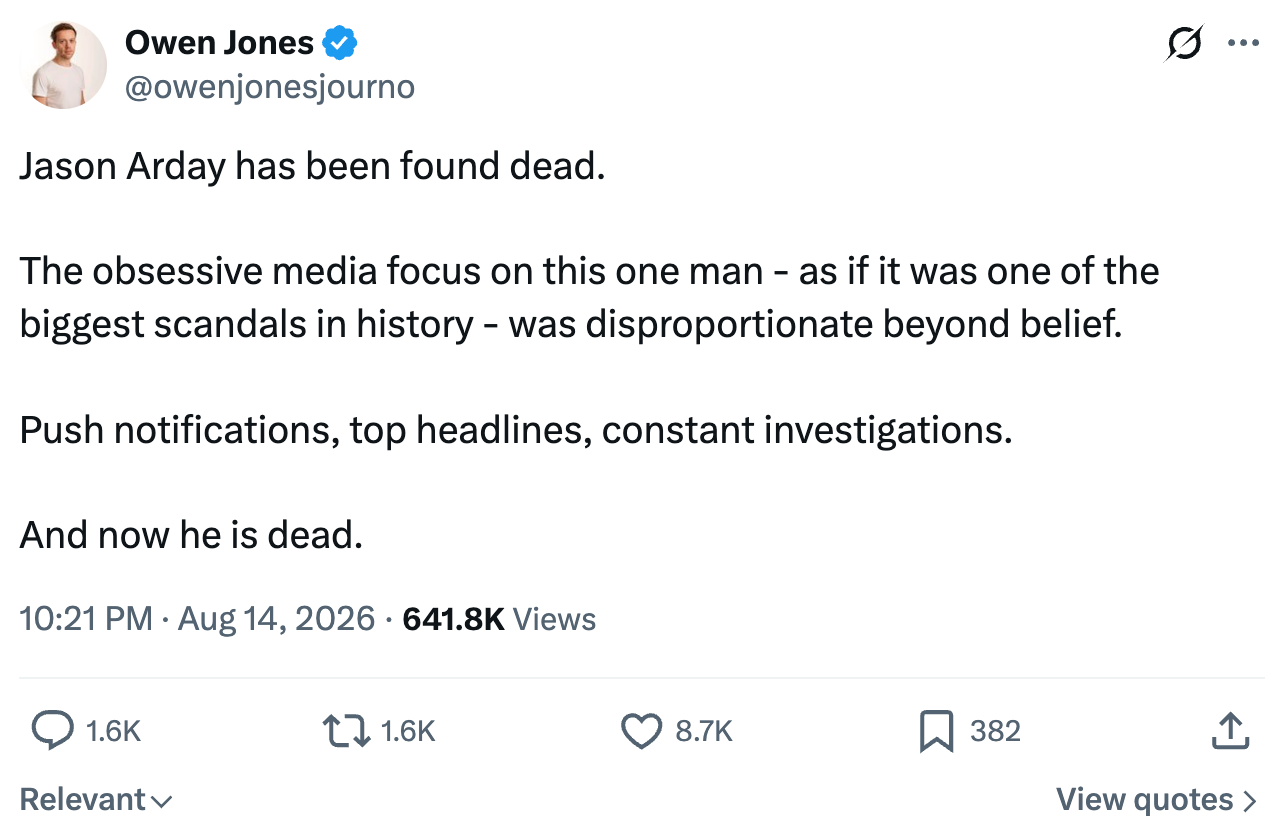
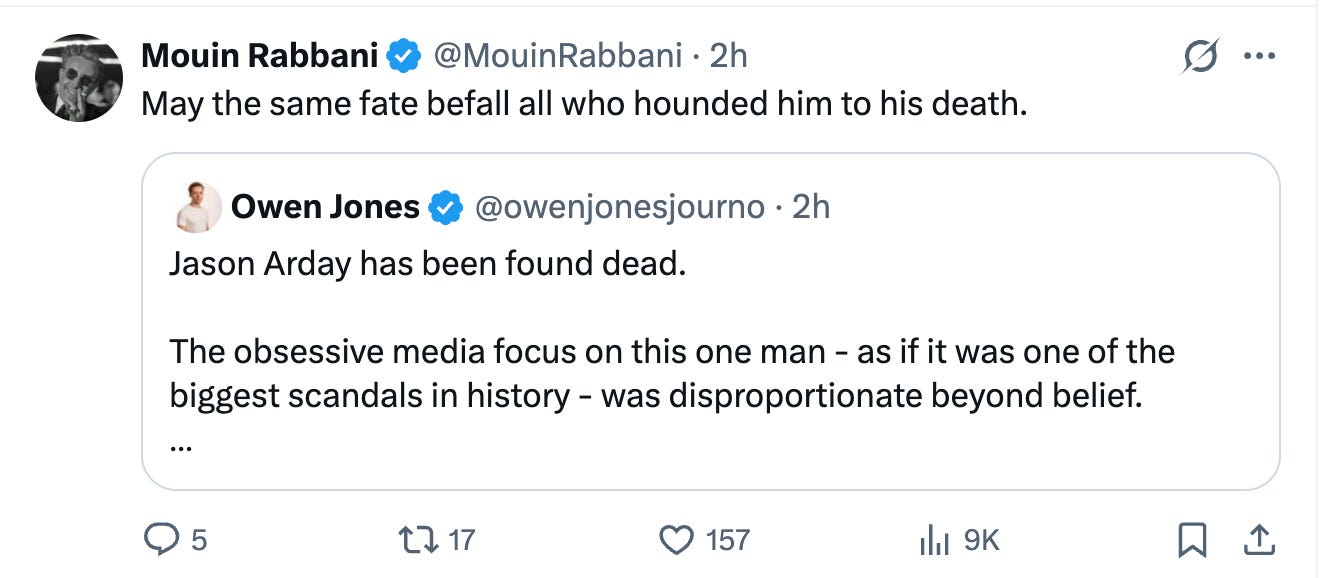
Jason’s family and friends are entitled to sympathy and condolences on the loss of someone dear to them. What I do reject, however, is the attempt of some pundits such as Owen Jones to pin the blame for this on media outlets that covered the story or those who exposed Jason’s lies and fraud. Nor does Jason’s death somehow provide a cover or excuse for whitewashing his record, which was vile.
For starters, I will reiterate what I pointed out in my previous post on Jason. Why was a lot of attention paid to his case? Because he occupied a position of prominence at a world renowned academic institution and was widely hailed in media and by his supporters as a genius and world-leading researcher in his particular field. ‘You are the best in the world in terms of the research that you do’- proclaimed his boss at Cambridge- Hilary Cremin- in a glowing BBC video hailing him as Cambridge’s ‘youngest ever black professor.’ Moreover, an integral part of Jason’s image was his extraordinary life story of triumph over adversity, if taken at face value: not speaking until age 11, not learning to read and write until 18, accomplishing remarkable marathon feats, raising massive amounts of money for charity and so on.
These issues alone made the stakes very high. If Jason’s remarkable image was in fact built on fraud and deceit in his research work and life story, then intense scrutiny was always going to be inevitable. If fakery was uncovered in his research, then questions were inevitably going to be asked about whether he was making up his life story too. If lies had first been uncovered in his life story, then it would have been natural to follow up on exploring whether deceit had also seeped into his research work.
The scrutiny was also intensified by the behaviour of Jason and his supporters. Attempts to raise concerns privately were ignored and suppressed by the institutions that should have done proper vetting and due diligence and advanced him to this position of prominence in the first place. Jason himself resorted to lawyers and the police to suppress a journalist’s efforts to get to the truth of allegations against Jason. When someone leaked details of grumblings against Jason to Nathan Cofnas, who published findings that clearly demonstrated Jason’s research fraud, the reaction of prominent supporters of Jason was to dismiss the charges as baseless and portray them as part of a smear campaign, when what they should have done- at minimum if they were not prepared to investigate for themselves- was acknowledge publicly that the charges were serious and needed to be examined without ideological prejudice. Or, they could have done the job of actually looking into the charges themselves, and they would have seen that there was substance to them and realised that Jason was a conman.
Once the scandal initially broke, Jason did little to alleviate the scrutiny he was under. If anything, he made it worse by not coming clean. He came up with an obviously bogus explanation for the plagiarism he had committed in his thesis. He denied deceit in his life story and made more implausible claims to the media. He told the Daily Mail to attribute a clarification to a ‘source’ close to him, when he himself had made the clarification. Once he finally resigned from Cambridge, he effectively refused to concede that he had done anything wrong.
It’s natural that Jason would have felt uncomfortable and stressed about the scrutiny he was under, but others have also been the subject of intense scrutiny amid high-profile scandal, and if they had committed suicide or otherwise died under stress, would that have been a reason to overlook the wrongdoing or terminate scrutiny?
Consider the case of Stephen Glass, the former New Republic journalist who committed fabrications in dozens of articles he wrote for the magazine and other high profile publications. Glass’ case arose in the late 1990s and predated the social media era, but it was a huge scandal in media at the time and justifiably so. He was writing for some of America’s most prominent publications and had attracted admiration as a perceived wunderkind in DC, churning out a steady stream of highly entertaining scoops. As is the case with Arday, the stakes were naturally high. He was fired once it had been established that he had completely made up one article- ‘Hack Heaven’- but understandably that case of complete fabrication raised the suspicion that he might have committed fabrications in other articles too. That suspicion, of course, turned out to be entirely correct. And let us suppose that Glass had cultivated a life story about himself that was extraordinary and added to the awe surrounding him: overcoming huge economic disadvantage, perhaps claiming he had been unable to read and write until he was 21, asserting he had performed various athletic feats that rivalled world-record holders. There would no doubt have been scrutiny of that story in the wake of the scandal surrounding his journalistic fabrications.
No doubt Glass felt very distressed as his journalism career collapsed, and perhaps he even had suicidal thoughts. But if he had actually gone ahead and committed suicide at the time because of the intense scrutiny, would that have been a reason to overlook his misconduct, or decry the media and those who exposed Glass as having ‘hounded’ him to his death? Of course not. Thankfully, Glass did not commit suicide. Instead, he came to realise he had done a huge amount of wrong and sought to turn his life around, and in my view he has turned his life around, even as there are undoubtedly some who will always dislike Glass for what he did and the scandal will likely form a key part of any obituary for him. As a partner of the law firm that hired Glass and still employs him today put it: ‘You were on track to be an asshole…The best thing that ever happened to you in your life is that you fell flat on your face.’ Very well put, I would say. Nowadays, people do not scrutinise Glass further because he is clearly very diligent and scrupulous in his work, and he has come clean about what he did wrong.
Those who wanted to support Jason amid the scandal and were concerned about his well-being should really have counselled him to take a similar course of action: come clean about his research misconduct and lies, cooperate with the investigations that had been launched into his work and life story, and pursue an alternative career path in a way that demonstrated real insight into and remorse for his past failings. Or if he was unwilling to fess up to wrongdoing, then they could have advised him to simply keep quiet and withdraw from the public space entirely.
In death, Jason has no explanation to offer us about what he did and why. That will inevitably invite more scrutiny, and the institutional investigations into his record and how he advanced to his position of prominence will have to take their course. I wish no pain or ill for Jason’s family and friends, but in death he does not become a hero or the victim in his scandal. Any judgement of his record has to be based on an honest assessment as to the veracity of his research and claims.
Not only is media however part of the blame goes to those who are obsessed with him, even after he's gone