

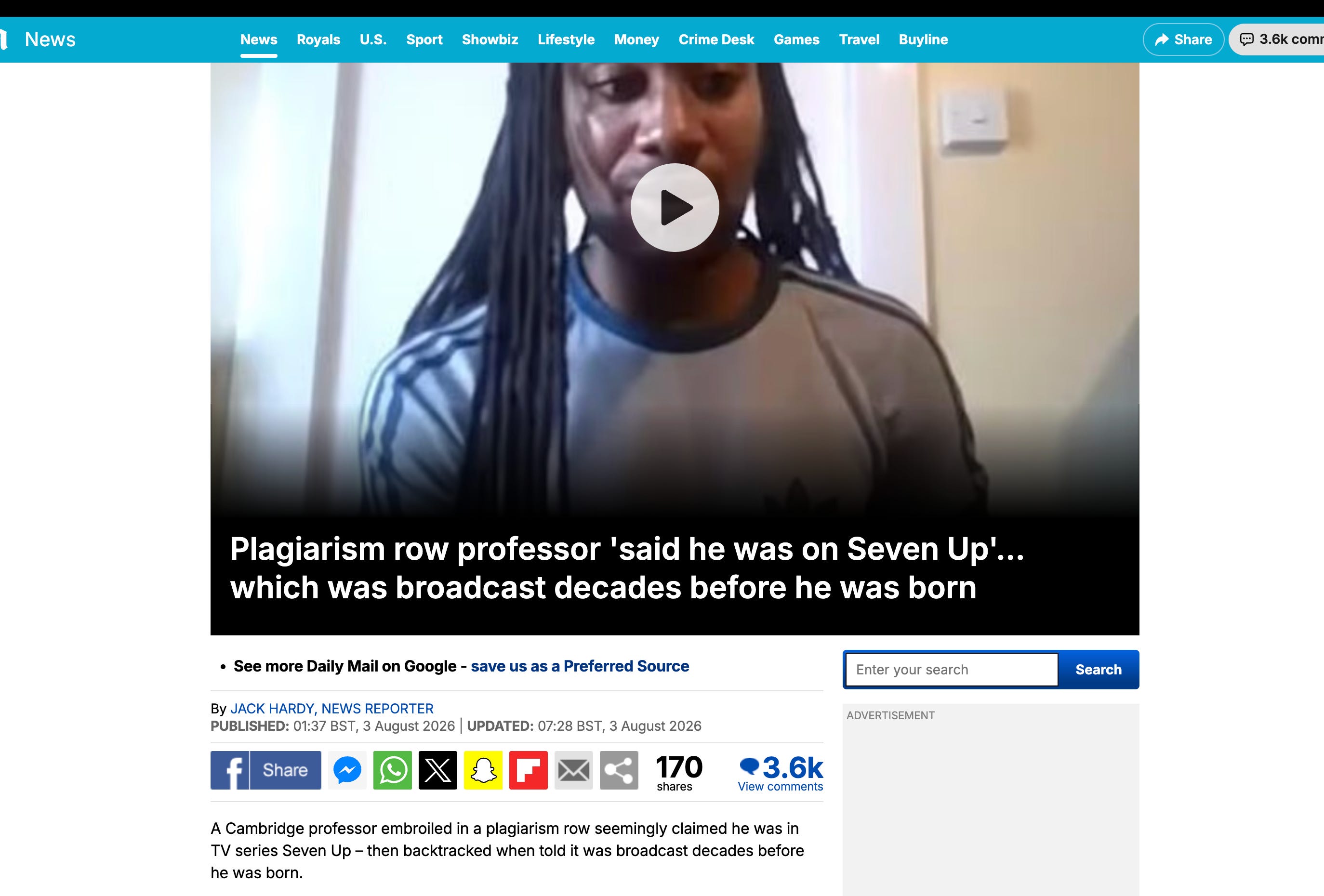
With each passing day since Nathan Cofnas first publicised Cambridge University professor Jason Arday’s serial plagiarism and research fraud, the evidence against Arday has only continued to mount, showing that he has not only committed research fraud but is also clearly a fantasist and pathological liar. Perhaps the most memorable recent example is his claim to have been on a TV series called ‘Seven Up’, only for him to tell the Daily Mail that he did not mean the TV series but rather ‘a local community and parent-led initiative developed around the Ubuntu principle that “it takes a village to raise a child”.’ Bizarrely, he asked the Daily Mail to attribute his clarification to a ‘source close to Professor Arday.’
Arday’s defenders are now unable to deny the evidence that they initially dismissed as ‘baseless’ but generally continue to play the race card, insisting that Arday is the subject of disproportionate attention because he is black, and that a white person caught in a similar scandal would not be so heavily criticised.
This line of apologia is nonsense. It is certainly true that there will always be some people who exploit any opportunity to make nasty comments on a personal level, and it is all the more inevitable in the era of social media, when anyone can use a platform to acquire a public voice. No doubt also there are some people who view the Arday scandal as confirming their racial prejudices against black people. But the notion that racism is primarily driving the scandal here or that a non-black person in a similar situation would not be the subject of intense scrutiny is not supported by the evidence. In truth, it is the Arday apologists who have sought to make the scandal about race more than anyone else. A case in point Nels Abbey, who signed a silly letter in support of Arday denouncing ‘entirely false allegations of plagiarism’ made against Arday and portraying the criticisms of Arday as racially motivated. In an interview with Times Radio, Abbey characterised the affair as another example of destroying movement towards ‘black liberation’ and ‘black equality.’
On the broadest level, what Arday’s apologists are claiming is another example of a common trope you can find all the time among commentators on the Internet and is partly the result of how social media algorithms can give a distorted sense of what is being covered in media: ‘Why are the media focusing on X and not covering Y?’- when a simple online search would show that Y does get media coverage. For instance, some readers of this blog may be familiar with how certain ‘pro-Israel’ commentators promote the childish trope of ‘No Jews, no news’- the idea that crimes and abuses committed by non-Jews do not receive media scrutiny and coverage, when even a cursory search would show that they transparently are investigated and covered. There is something to be said about whether the Israeli-Palestinian conflict receives disproportionate attention compared to other conflicts, but I would argue that is primarily because activists and partisans on both sides are so vocal and seek to place the conflict at the centre of public attention.
Back to Arday: what is primarily driving the level of scrutiny in his case is the fact that he occupies such a prominent position in academia (the ‘youngest black professor’ ever to be appointed at Cambridge University, one of the world’s leading universities) and was so widely celebrated in academia and media as an extraordinary public intellectual with an extraordinary story, often in terms that were embarrassingly sycophantic and fawning. When you are this high profile and have been lauded in such a way, the stakes are naturally going to be very high and any sense of a scandal will attract a good deal of attention. The fallout and scrutiny will be all the greater if it comes to light that earlier internal attempts to raise and resolve concerns were subject to intimidation and suppression, as happened in Arday’s case. The fallout and scrutiny will also increase if the person at the centre of the scandal fails to give a proper acknowledgement of wrongdoing and show insight and remorse- something that also applies to Arday’s case.
The truth is there are multiple examples of research scandals involving white writers, researchers and public figures that attracted prominent public attention, but I do not think any of them can be put down to some racial, social or gender bias. In particular:
. Karl Theodor zu Guttenberg: he rose to prominence as Germany’s defence minister. From the various accounts I have seen, he was not exactly deemed incompetent at the job, but once it came to light that he had committed substantial plagiarism in his doctoral thesis, a scandal ensued, as a result of which his doctorate was revoked and he resigned his position as defence minister. This scandal took place in early 2011, before Twitter/X really took off as a platform. Nonetheless, the scandal attracted a great deal of media attention at the time, heightened no doubt by the fact that Karl initially denied committing plagiarism and resisted calls to step down.
. Jonah Lehrer: once a popular neuroscience writer who sold best-selling books, he initially attracted controversy over ‘self-plagiarism’ and then was caught out for fabricating data and lying to cover up his fabrications. I would urge anyone to do a cursory search and see that this scandal attracted widespread media attention in the U.S. Lehrer’s attempts to make a comeback also never succeeded.
. Paolo Macchiarini: already touched on in the previous post, the Italian surgeon was initially hailed as a pioneer in regenerative medicine. He had a position at a world-leading medical research centre- the Karolinska Institute- and was also the subject of a sympathetic though not entirely uncritical documentary produced by NBC. It became clear though that he had committed research fraud and his artificial tracheas did not work, and he was also exposed as a fantasist in his personal life, pursuing multiple affairs with women while telling one of them (a producer who worked on the NBC documentary and fell in love with him) that the Pope would officiate their marriage in a wedding to be attended by the Obamas, Clintons and Vladimir Putin (yes, really). While Karolinska and the Lancet journal had initially sought to defend him, Macchiarini lost his positions and was eventually sentenced to 30 months in prison for three counts of aggravated assault in relation to his surgeries with artificial tracheas. The fraud and fantasist is even the subject of a Netflix series entitled ‘Bad Surgeon’.
. Francesca Gino: once a professor at Harvard’s Business School, she lost her tenure in a very rare case after being found guilty of fabricating research data. Her case was also the subject of intense media scrutiny.
In fact, in his interview with Times Radio, Nels Abbey himself somewhat inadvertently captured the essence of why he is being scrutinised so heavily:
'Jason Arday is one of the best of us. He’s an absolutely brilliant young man, a veritable genius who’s overcome a significant amount to get to where he is, and he deserves to be where he is.'
In response to which Times Radio presenter Nick Wallis rightly asked: 'If you’re publicly calling him a genius, then he’s obviously going to have his record examined. If you celebrate someone as being so exceptional, so extraordinary…of course people are going to ask questions.'
I do not intend to turn this newsletter into a day-by-day or weekly news report on the latest punditry and revelations regarding Arday. I believe the case is now and has been sufficiently clear for some time: Arday is a total fraud and should not have any place at Cambridge or another university as a professor or researcher. However, scrutiny, questions and pressure will inevitably continue the longer he and his supporters try to maintain that he is fundamentally a victim in this story. Instead, as journalist Oliver Kamm advises, those who are concerned for Arday’s well-being should simply advise him to resign and cancel his memoir, and (I would add) issue a full public apology for his research fraud and lies. There also needs to be a serious reckoning among both the institutions that enabled Arday and Arday’s apologists about how they have behaved during this entire affair. Do they want academia of the humanities and social sciences to be a place of serious research, or a place that confirms populist suspicions about public money being wasted on exercises in navel-gazing, incomprehensible jargon and ideological prejudices?