

In an earlier post examining the Chronicon Iriense, it was noted how appealing to pre-Islamic conquest Iberian history could serve propagandistic purposes for churches in the peninsula in the medieval period as they sought to delineate their territory and authority. The Chronicon Iriense did so for the church of Santiago de Compostela by tying the origins of its predecessor church- Iria Flavia- to a settlement founded by a runaway Trojan princess and an endowment by Miro/Mirus, a king of the Suevi, a Germanic people who ruled the northwest of the Iberian peninsula encompassing parts of modern-day Spain and Portugal during the fifth and sixth centuries CE. Their realm was subsequently subjugated by the Visigoths.
The Parrochiale Suevum (‘Parish Division of the Suevi’) is a similar document of interest. It purports to represent an ecclesiastical division of the region of the Galicia (located in the northwest of the peninsula, more extensive here than the modern autonomous community of Galicia in Spain) during the rule of the Suevic king Theodemir, who, according to Isidore of Seville, restored the Suevi to the Catholic faith after a period in which the Suevi had fallen into the error of Arianism, which is deemed a Christian heresy for positing the Son is not co-eternal with the Father but rather was created at a point in time and was lesser than the Father. Theodemir was also Miro’s predecessor, according to Isidore. The purported division is dated to 569 CE, and divides the territory of Galicia into 13 dioceses encompassing more than 100 parishes. Since the purported division took place during the reign of Theodemir, the text is also referred to by scholars as the ‘Division of Theodemir.’
While it cannot be definitively ruled out that the document (of which there are six copies) could partially reflect an actual ecclesiastical division during Suevic rule in the sixth century CE, it is reasonable to suspect that there has been interpolation in certain parts by forgers seeking to stake out territorial claims for their churches in later centuries.
The most evident case of manipulations pertains to the church of Lugo (located in modern northwest Spain), which contains one of the six existing versions of this document. Fernando López Alsina suggests three manipulations here.
First, the names of many parishes affiliated with Lugo are omitted, with the document instead specifying that Lugo should possess adjacent areas ‘held by 11 counts.’ It is likely that this specification is tied to the diocese of Lugo’s claim to have ecclesiastical jurisdiction over the territory surrounding Lugo during the 11th century CE, at a time when at least part of this territory was being administered by other sees like Oviedo. If the restored sees of Tuy, Ourense and Braga received episcopal jurisdiction over their surrounding territories in their dioceses, the same principle should apply to Lugo.
Second, the territory of Asturias is attributed to Bretoña. Bretoña’s name points to a migration of people from Britain to the northwest coast of Iberia, and in ecclesiastical terms Bretoña was originally a personal rather than territorial jurisdiction. Bretoña’s episcopal successor was Mondoñedo. By assigning ‘Asturias’ as its territorial jurisdiction, the manipulation puts Mondoñedo at odds with Oviedo, asserts Lugo’s claims to authority over territory within Mondoñedo’s diocese, and rejected Oviedo’s right to assert jurisdiction over churches Lugo asserted were under its authority in accordance with the sixth century CE. In short, Lugo’s ecclesiastical jurisdiction would extend to the Cantabrian coast.
Third, the list of parishes for Iria includes four that are not attested in the sixth century CE: Prucios, Besancos, Trasancos and Lapaciencos, which constituted four ‘arch-priesthoods’ (groups of small parishes under an archpriest) at the end of the 11th century CE and are located in the far north of what is now A Coruña province in Spain. By assigning the four locales to Iria, the text would arguably have been well received by Santiago de Compostela, which contested these locales and others with Mondoñedo. All that said, it should be noted that the existing copy of this text found at Lugo does not contain these various extra localities for Iria. Rather, they are found in four other existing versions of the text: namely, Ourense, Santiago de Compostela, Coímbra and one of the two versions at Braga.
Below is my translation of the Latin text per the edition provided by Alsina in his study, which he deems to be the version that was promulgated by the church of Lugo during the tenure of Bishop Vistruario in the latter half of the 11th century CE. For a full list of the locales listed in the six existing versions of the text, see this study in 2020 by Renzi and Mariani.
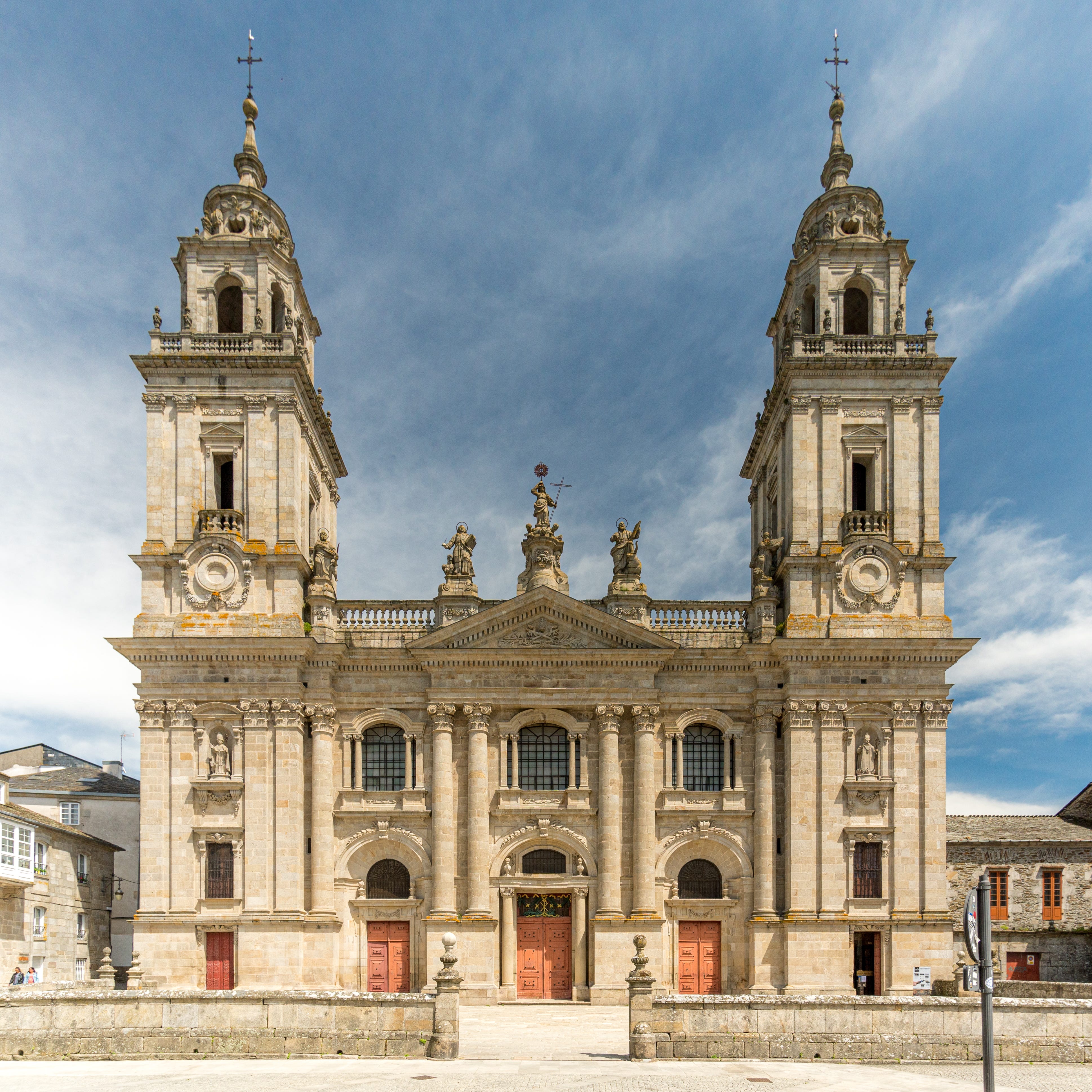
The cathedral at Lugo in northwest Spain
Parrochiale Suevum
In antiquity, the number of dioceses that each see was prescribed to have
In the time of the Suevi, on the Kalends of January in era 607, the Suevi’s ruler Theodemir ordered a council to be convened in the city of Lugo in order to affirm the Catholic faith and discuss various church matters. After they dealt with whatever came up in the council, the king sent his letter to the bishops who had been assembled there. The letter contained these words: ‘I desire, most holy fathers, that you should make a decision regarding our province with a prudent view as to what is beneficial. For in the entire region of Galicia that is quite vast, the dioceses are held by a few bishops, such that some churches can hardly be visited by their bishop each year. In addition, there is only one metropolitan bishop in charge of such a great province, such that it is wearisome for the remotest parishes to convene for the council each year.’ When the bishops read this letter, they decided in a synod that the see of Lugo should be a metropolitan one just like the see of Braga, because there was the boundary for neighbouring bishops, and because there was always a great gathering of the Suevi at the locality of Lugo. In addition, in that council they chose other sees for ordination of bishops. And thus through each cathedral they divided the dioceses and parishes lest there should be any dispute between the bishops. The division was as follows:
1. To the cathedral of Braga belong these churches that neighbour it:
- Centumcellas
- Coetos
- Lemeto
- Anoaste
- Milia
- Ciliolis
- Ad portum
- Agilio
- Carandonis
- Tauvis
- Ciliotao
- Cetanio
- Oculis
- Cerecis
- Petroneto
- Equesis
- Ad saltum
. Also these villages:
- Pannonias
- Laetera
- Brigantia
- Astiatico
- Tureco
- Auneco
- Merobrio
- Berese
- Palantucio
- Celo
- Supelegio
- Senequio
30 churches in total
2. To the see of Porto, in the new fort, belong these churches that neighbour it:
- Villanova
- Betaonia
- Visea
- Menturio
- Torebria
- Bauvaste
- Bonzoaste
- Lumbo
- Nescis
- Napoli
- Curmiano
- Magneto
- Leporeto
- Melga
- Tongobria
- Villa Gomedei
- Tauvasse
Also these villages:
- Labrencio
- Aliobrio
- Valle Aritia
- Truculo
- Cepis
- Mandolas
- Palentiaca
25 churches in total
3. To the see of Lamego: Lamego itself, plus:
- Tuentica
- Aravoca
- Cantabriano
- Omina
- Camianos
Six churches in total
4. To the see of Coimbra, Coimbra itself, plus:
- Eminio
- Selio
- Lurbine
- Insula
- Antunane
- Old fort of Porto
Seven churches in total
5. To the see of Viseo, Viseo itself, plus:
- Rodomiro
- Submontio
- Suverbeno
- Osania
- Ovellione
- Tutela
- Coleia
- Caliabrica, which was subsequently a see for the Goths.
Nine churches in total
6. For Dumio, the family of servants.
7. For the see of Egitania, all of Egitania, plus:
- Municipio
- Francos
Three churches in total
8. For the see of Lugo, the city of Lugo and its adjacent areas which are held by 11 counts, together with:
- Carioca
- Sevios
- Cavarcos
9. For the see of Ourense:
- Palla Aurea
- Verugio
- Bibalos
- Teporos
- Geurros
- Pincia
- Cassavio
- Verecanos
- Senabria
- Calapacios Maiores
11 churches in total.
10. For the see of Astorga, Astorga itself, plus:
- León.
- Bergido
- Petra Speranti
- Conianca
- Ventosa
- Maurelos Superiores and Inferiores
- Senimure
- Fraucelos
- Pesicos
10 churches in total.
11. For the seat of Iria, Iria itself, plus:
- Morracio
- Salinense
- Contenos
- Celenos
- Metacios
- Mercienses
- Pestemarcos
- Coporos
- Celticos
- Bregantinos
- Prutenos
- Prucios
- Besancos
- Trasancos
- Lapaciencos
- Arros
12. To the see of Tuy, the churches that neighbour it:
- Turedo
- Tabulela
- Lucoparre
- Aureas
- Langetude
- Carisiano
- Marciliana
- Turonio
- Celesantes
- Toruca
Also these villages:
- Aunone
- Sacria
- Erbilione
- Cauda
- Ovinia
- Cartas
17 churches in total.
13. To the see of Britoña belong the churches that are among the Britons, together with the monastery of Máximo and Asturias.
Dear Aymenn, as a lapsed Classics scholar and then Middle East diplomat, I really value your substack. Thanks.