

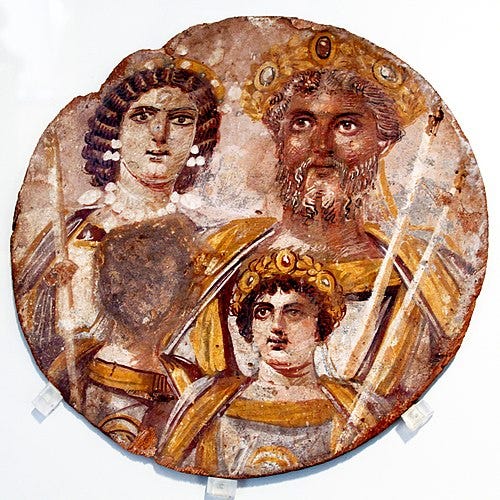
On social media, one occasionally finds certain characters who portray themselves as opening up access to primary sources about the ancient and medieval worlds in the face of a politically correct or ‘woke’ consensus in academia, which is supposedly conspiring to shield the masses from access to those sources and thus prevent them from demolishing silly ideological trends and claims in academia and popular discourse. ‘Roman Helmet Guy’, framing himself as ‘tribune of the plebs’ (reflecting his vox populi stance), is the latest example of this trend.
As I have outlined before, from my perspective, the more who can read sources in the original Latin instead of just relying on translations (whether human or AI-produced), the better. I cannot speak for the entirety of academia, but with the long-term threat to the financial viability of ancient and medieval history programs at universities, I am sure many academics would welcome taking in more students to study Latin as part of ancient and medieval history courses.
In this post, I will comment briefly on a recent controversy that exemplifies the need for proper study of ancient and medieval texts in their original languages, removed from ideological prejudices. Responding to a pundit’s claim that the Roman emperor Septimius Severus was ‘literally black’, ‘Roman Helmet Guy’ claimed that ‘the primary sources say Septimius Severus was so afraid of Black guys he thought seeing one was a bad omen.’
What do the primary sources say? Cassius Dio, in a fragment of Book 19 of his Roman History, describes Septimius as ἐκ γενους ὠν του Λιβυκου, which can be translated as ‘being of Libyan descent’ or ‘being of Libyan race.’ The Historia Augusta, which is deemed unreliable in many places, describes Septimius as Africa oriundus (‘having been born in Africa’), saying specifically that he was from the town of Leptis, probably referring to Leptis Magna in what is now Libya.
Based on this evidence, I agree with the objection raised by ‘Roman Helmet Guy’ to the notion that Septimius was ‘literally black’ as is understood in the conventional sense, but rather he may have had some North African ancestry. ‘Africa’ in Latin texts- both ancient and medieval- refers to the region of North Africa, especially the area of modern-day Tunisia and the environs of modern-day Libya and Algeria. By extension, an Afer (‘African’; pl. Afri) refers to a person of that region. For example, in his Historia Romanorum (13th century CE- chapter 7), the Toledan archbishop Rodrigo Ximénez de Rada describes Carthaginian general Hamilcar Barca (father of Hannibal) as rex Afrorum (‘king of the Africans’), clearly using it as a synonym for Poeni (‘Punic people’- i.e. the Carthaginians, who originated from Phoenicia and settled in North Africa), since in the next chapter he describes Hannibal as rex Penorum (‘king of the Poeni’). Similarly, in his Historia Gothica that includes an account of the Muslim conquest of Spain, he speaks of the invading army as ‘African’, but it is clear that in the most literal sense he means that the invading army crossed into Spain from North Africa. Given the author’s use of the word ‘African’ throughout his texts and the wider context, Rodrigo means that the invading army was composed of both Arabs and the people of North Africa commonly deemed Berbers in Arabic texts and modern parlance.
In short, Septimius may have had Punic and/or Berber ancestry, and was certainly not black African. However, the characterisation by ‘Roman Helmet Guy’ of Septimius as being afraid of black people in general to the point that he regarded them as a bad omen is a misrepresentation of the evidence he cites, even assuming the material should be taken as completely historically reliable. In particular, the Historia Augusta narrates this anecdote as an example of something that foreshadowed Septimius’ death:
Post murum apud vallum visum in Brittannia cum ad proximam mansionem rediret non solum victor sed etiam in aeternum pace fundata volvens animo, quid ominis sibi occurreret, Aethiops quidam e numero militari, clarae inter scurras famae et celebratorum semper iocorum, cum corona e cupressu facta idem occurit. Quem cum ille iratus removeri ab oculis praecepisset et coloris eius tactus omine et coronae, dixisse ille dicitur ioci causa…
(‘After seeing a wall at a fortification in Britain, Septimius was returning to the nearest dwelling, not only as victor but having established permanent peace [there]. He was wondering in his mind what sort of omen might come to him, when a certain Ethiopian from the military rank, who was famous among the jesters and always told renowned jokes, encountered him while bearing a garland made of cypress. When Septimius, angered and troubled by the omen of his colour and the garland, ordered for him to be removed from his sight, he [the Ethiopian] is said to have said as a joke…’).
Ethiopia is a standard term in the ancient texts for a region located south of Egypt. For example, in the Res Gestae, Augustus asserts that his armies reached ‘Nabata’ in Ethiopia, ‘which Meroe is near to’ (corresponding to the site of Meroe in what is now Sudan). An Aethiops by extension is a person from this region south of Egypt. Given this context and the passage in the Historia Augusta, it is reasonable to infer that the ‘Ethiopian’ who encounters Septimius is black as understood in the conventional sense. However, as the Latin text indicates, it is not merely the person’s skin colour that troubles him: it is rather both his skin colour and the garland that together form an ‘omen’ (coloris eius tactus omine et coronae). The English translation relied on by ‘Roman Helmet Guy’ somewhat misses the sense of the original Latin by speaking of ‘the man's ominous colour and the ominous nature of the garland.’ If the original writer had wanted to emphasise that the skin colour by itself was ominous and the garland by itself was ominous, he would have surely rendered the phrase along these lines: colore eius ominoso tactus et corona ominosa. I should say I was not the first to raise this issue of the contrast between the cited translation and the original text, but it sure helps to know Latin and confirm it.
Of course, it is not unreasonable to speak of ethnic prejudices in the ancient world, but it is an exaggeration to describe Septimius, on the basis of this evidence alone, as having regarded black people in general as a bad omen.
To reiterate therefore, it is in my view great to have people study Latin and other languages to read ancient and medieval primary source texts in the original rather than just depend on translation and AI. But such study should be divorced from ideological agendas about supposedly destroying the ‘Marxist’ or ‘woke’ conspiracy that has seized control of academia.