

Not too long ago, the analyst Aaron Zelin noted that the Syrian president Ahmad al-Sharaa has great admiration for Abd al-Rahman al-Dakhil, who established an independent Umayyad emirate in al-Andalus (the Muslim-held parts of Iberia) in 756 CE. Why is that so and how, if at all, is that admiration relevant for understanding al-Sharaa’s vision for Syria today?
On one level, in representing a revival of Umayyad authority following the collapse of the Umayyad Caliphate in the Middle East in the mid-eighth century CE, the figure of Abd al-Rahman al-Dakhil (whose epithet translates as “the one who enters”) dovetails with the pro-government ‘Umayyad populism’ that exists among parts of the Sunni Arab constituency and has been documented before.
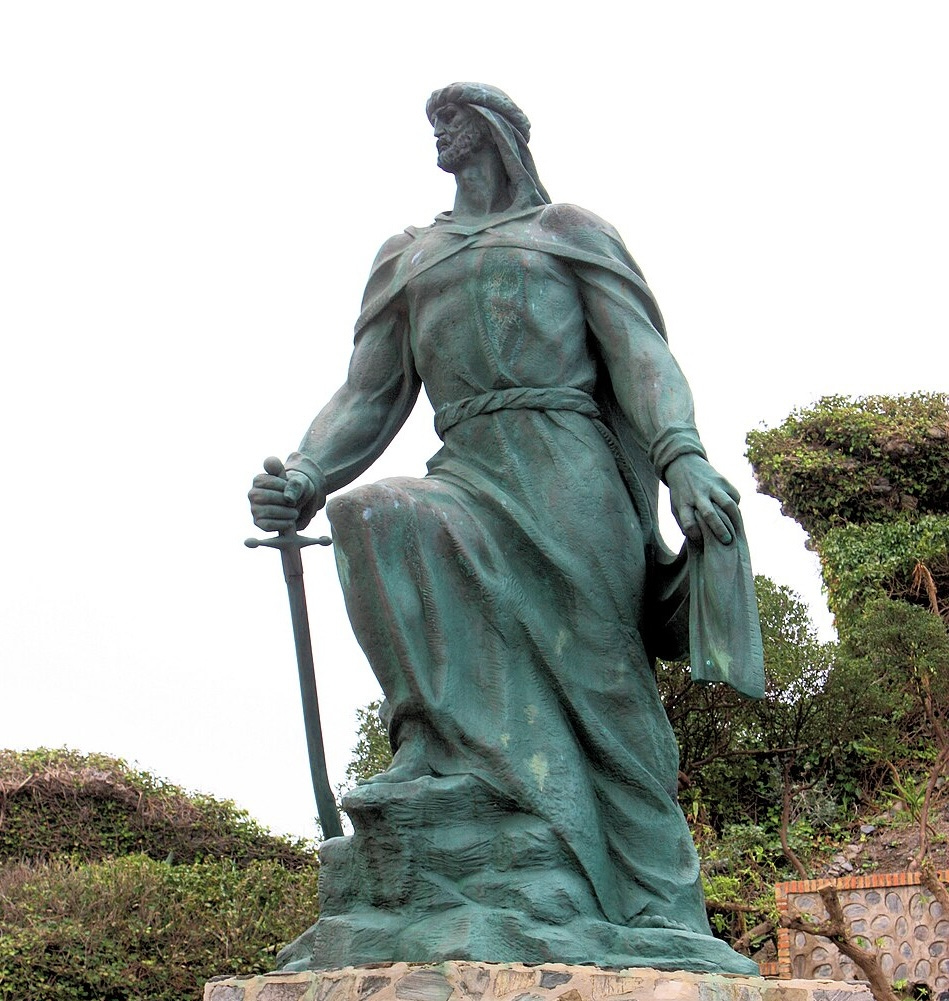
Modern statue depiction of Abd al-Rahman al-Dakhil
But a closer look at Abd al-Rahman al-Dakhil’s career from the historical source materials also shows some parallels with al-Sharaa’s career and vision. After fleeing from the Levant region and then entering al-Andalus via North Africa, he initially focused on seizing the main centre of power in Cordoba that was held by Yusuf al-Fihri who was essentially ruling al-Andalus as an independent entity since central Umayyad authority over al-Andalus was effectively lost by the late 740s CE.
Abd al-Rahman accomplished his immediate goal of securing Cordoba in 756 CE, but the source material superficially gives the impression that much of his reign in al-Andalus was characterised by ‘rebellions’ against his rule, and consequently there is very little detail in those sources about the process of state-building. For example, Kitab al-Bayan al-Mughrib- a work by the fourteenth century CE Moroccan historian Ibn ‘Idhari, documents the following ‘rebellions/revolts’:
. A revolt by Yusuf al-Fihri after he initially surrendered rule to Abd al-Rahman, culminating in his assassination at Toledo by a companion seeking to curry favour with .
. A revolt by Abd al-Ghafir al-Yamani in Seville.
. A revolt by Haywa bin Mulamis in Seville and the west of al-Andalus.
. A revolt in 763-764 CE by al- ‘Ala bin Mughith al-Judhami at Beja, calling for allegiance to the Abbasid caliphate.
. A revolt in 764-765 CE by Hisham bin ‘Urwa at Toledo.
. A revolt in 766-767 CE by Sa‘id al-Yahsubi, who seized Seville and reputedly enjoyed support from tribesmen of Yemeni origin. In addition, Abu al-Sabbah al-Yahsubi, who had been appointed as governor of Seville, was removed by Abd al-Rahman and thus revolted. Abd al-Rahman then had him killed.
. A revolt by Berbers in some mountainous regions beginning in around 767-768 CE, with many of them rallying around ‘al-Fatimi’ and lasting until 776-777 CE.
. A revolt by Abd al-Ghafir al-Yahsubi, based out of the region of Seville and western al-Andalus in the years 772-774 CE.
. A revolt by Abd al-Rahman bin Habib al-Fihri based out of Tudmir (a region of eastern al-Andalus, corresponding roughly to the area of Murcia and Valencia) in 779-780 CE.
. A revolt by al-Rumahis bin Abd al-Aziz (governor of Algeciras on the southern coast) in 780-781 CE.
. A revolt by al-Husayn al-Ansari in Zaragoza, dated to 781-782 CE.
. A conspiracy against Abd al-Rahman in 784-785 CE by al-Mughira bin al-Walid bin Mu‘awiya.
. A revolt by Muhammad bin Yusuf al-Fihri (who had escaped Abd al-Rahman’s custody), based out of the regions of Toledo and eastern al-Andalus, beginning in 785-786 CE.
. A revolt by Yusuf al-Fihri’s brother in 787-788 CE.
In the Historia Arabum (“History of the Arabs”), the Toledan archbishop Rodrigo Ximénez de Rada notes in passing that there were many ‘revolts’ against Abd al-Rahman, but uses a rather interesting turn of phrase. Namely, he says that those who rose up did so in unum facticii (lit. “forged into one”), instead of the simpler Latin adverb pariter (“together”). In my view, his phrasing implies that the revolts superficially conveyed the impression of being united and driven by a common agenda but may not have in fact been so.
Indeed, looking closely for comparison at more detailed accounts provided by Kitab al-Bayan al-Mughrib and the anonymous Fath al-Andalus, we can question what exactly is meant by a ‘revolt’ against Abd al-Rahman. Does it mean an attempt to depose him and enact regime change (something that is very likely the case in al- ‘Ala bin Mughith al-Judhami’s call for allegiance to the Abbasids)? Or does it mean an attempt to assert autonomy and independence (possibly the case with the Berbers in the mountainous areas)? Or does it mean a refusal to recognise Abd al-Rahman’s rule in the first place (perhaps Hisham bin Urwa at Toledo being one such case)?
In any case, it is clear that Abd al-Rahman sought to consolidate his authority over the entirety of al-Andalus and did not accept the idea of fiefdoms asserting autonomy and independence from his hegemony. It is also clear that the Arabic source material generally views his reign positively and glorifies him as a unifier of al-Andalus and restorer of the original Umayyad sovereignty. It is this theme, for example, that probably explains the imbalance in Fath al-Andalus where it devotes considerable attention to Abd al-Rahman’s reign but has comparatively little to say about his successors. Assuming a redaction in the early twelfth century CE, the author was likely contrasting the glory of unification with the division of al-Andalus into petty realms following the collapse of the Umayyad state there in 1031 CE.
Looking at al-Sharaa’s career for comparison, one can see a clear parallel in how al-Sharaa has sought to achieve unification under his hegemony. In fact, a key rationale behind the group he founded and led prior to the fall of the Assad regime- namely, Hay’at Tahrir al-Sham (HTS)- was that the insurgency in northwest Syria could no longer be divided into multi-factional fiefdoms but rather needed to be united under its own hegemony. When negotiations along those lines failed, HTS resorted to force (just as Abd al-Rahman did not shy away from using force), defeating its rivals by 2019, who were either expelled entirely or were allowed to remain on condition of accepting the hegemony of HTS and its Salvation Government. So also, prior to the fall of the Assad regime, the group sought, within the limits of what was realistically possible, to extend its influence into the areas controlled by the Turkish-backed ‘Syrian National Army’ factions. As is the case with Abd al-Rahman’s rivals, HTS’s rivals may have had varying motivations, with some (like Ahrar al-Sham’s leadership) perhaps generally seeking to consolidate a larger rival political project, and others being more concerned with retaining control of local strongholds.
Today, with Ahmad al-Sharaa as president of Syria, there is much debate about his long-term vision. Some scenarios- such as the supposition that he is somehow waiting for a right moment to realign with global jihadism, revive the Caliphate and destroy the West- strike me as implausible in the extreme. But one thing is at least clear: just as Abd al-Rahman is seen as the unifier of al-Andalus, so al-Sharaa sees himself as the unifier of Syria. He consistently speaks of the need for a unified Syria and has clearly shown that he rejects notions of autonomous regions or federalism. Notions of unity and rejection of federalism, of course, also resonate at the popular level. All his negotiations with other actors, most notably the Kurdish-led Syrian Democratic Forces (SDF), have been conducted with the aim of ending any autonomous or rival political projects that do not accept his leadership and hegemony as president of Syria.
When negotiations to achieve such unity have ultimately come to an impasse, al-Sharaa has also shown himself willing to use force, as is the case in al-Suwayda’ last summer (which was only averted by Israeli intervention that caused high casualties among government forces) and now with the SDF in Aleppo, Raqqa and Dayr al-Zur provinces, correctly calculating that the SDF is at a disadvantage in terms of manpower and weaponry, lacks a popular support base in many if not most Arab majority areas it rules, and will not be rescued here by the U.S.-led coalition in the form of direct military intervention against his forces. In this respect, securing Trump’s personal support has constituted a significant strategic gain.
And so while the al-Suwayda’ frontlines by contrast may appear frozen for now, there is also little doubt that al-Sharaa is still seeking to dismantle the Hikmat al-Hijri-endorsed ‘National Guard’ project of local Druze factions. Right now, through restricting the entry of goods and aid into the ‘National Guard’-held areas, he is undoubtedly trying to put economic and humanitarian pressure on them to come to the table, end the impasse and agree to accept his authority. The pressure on the SDF also serves as an additional pressure tool to throw the ‘National Guard’ project and its supporters’ notions of autonomy or independence into doubt.
In short, al-Sharaa’s admiration for Abd al-Rahman al-Dakhil is primarily relevant for understanding his insistence on a centralised form of governance for Syria centred around his strong executive authority as president. This vision may require use of force to achieve if deemed necessary.
Interesting piece! I agree that ash-Sharaa wants to keep Syria unified, but that hardly leads to comparisons with one of the greatest political stories in world history in Abd al Rahman.
Ash-Sharaa is a Jihadist from Qaeda and ISIS, which means not only is he a criminal and a murderer, he harkens back to some imagined past in an attempt to recreate it. Using the State to relive the past always creates dystopia, see, for example, Palestine, Nazi Germany, the USA in the War on Terror since 2001, and now Syria thanks to the US invasion of Iraq and arming of Jihadists to attack Syria. In contrast, Abd al Rahman led a real life, not an imagined one, as the lone surviving Umayyad in Syria after the Abbasid from Raqqa massacred his entire family. The Abbasid flew the black flag from Raqqa, which is the flag ISIS bears. Ash-Sharaa and his ilk harkened back to the massacre of Umayyad Syria by the Abbasid just as the Zionists harken back to the genocide of the Canaanites by the Habiru. By reference to Abd al Rahman, ash-Sharaa hopes to put himself on the right side of Syria, and the right side of history, but the truth cannot be ignored. He flew the black flag armed and instigated by the US, Turkiye, and Israel. He's an Abbasid, not an Umayyad.
Ash-Sharaa is nothing like Abd al Rahman. Abd al Rahman created a caliphate in Cordoba that lasted 300 years, and it combined Muslims, Christians, and Jews in a syncretic, if fitful, state, that became the jewel of the Middle Ages. When Abd al Rahman landed at Cueta in 756, he was cheered as the local army surrendered. He took several towns without a fight before battling Yousef al-Fihri's army outside of Cordoba -- Yousef was not in the battle, it was led by his commander who later died in prison. After his victory, Abd al Rahman waited 3 days to enter the city in order to allow all of the al-Fihrid and their allies to depart. When he entered the city, he pardoned all those who stood against him, which was indeed intended as a unifying act. But, when Abd al Rahman built his palace on the Guadalquivir ten years later, he planted Syrian date palms and wrote a poem about Syria. "I, like you, am far away from home," he wrote. I cannot imagine ash-Sharaa writing a poem. I don't think I would want to read it. I don't want to know what's in his head.
Four additional historical facts about Andalus that bear noting: (1) the Umayyad Empire was over 60% Christian and Sephardic in the 8th century when it united the Mediterranean for the first time since the Romans. (2) The Muslims were kicked out of Reconquest Spain for resisting the genocide of the Sephardic Jews by the Catholics of Aragon in 1492. When the Catholics started kicking out the Jews, the Muslims rose up and resisted. That's why the Catholics then kicked out all of the Muslims from Muslim Spain. (3) The Sephardi who left Spain instead of converting went north into Europe, where they became the Ashkenazi, which means "the Northerners." The Muslims mostly went south into North Africa. The Ashkenazi are European, northerners, not Middle Eastern. (4) The Castilians who perpetrated the genocide of Jews and Muslims in Spain were the same Castilians who explored the Americas and perpetrated the same harms on the Native people there with the Conquistadors and their Franciscan and Jesuit priests. And, BONUS FACT, (5) in the Pueblo Revolt of 1680, the Hopi cut the heads off of all Franciscan priests on the Three Mesas, dug up their Missions, and scattered them to the Four Winds. Al hum du lilah! The Hopi invented a new word to describe the abusive Franciscans, "Totatsi." A priest who abuses his power. If there was a word before Nazi to describe a Nazi, it was Totatsi.