

Today marks the official release of my latest book by Manchester University Press- an English translation and study of the ‘Minor Histories’ by Rodrigo Ximénez de Rada (d. 1247 CE), who served as the archbishop of Toledo during a crucial transitional period in medieval Iberia as power shifted decisively in favour of the Christian kingdoms at the expense of Muslim sovereignty.
The ‘Minor Histories’ are effectively supplements for Rodrigo’s larger ‘History of Spain’ project that was commissioned by King Ferdinand III of Castile and León. The main bulk of that project is the ‘Gothic History’ whose title highlights the theme of continuity between Iberia’s Christian kingdoms and the Visigoths who ruled Spain prior to the Muslim conquest. The ‘Minor Histories’ explaining how various other foreign peoples (e.g. the Romans) contributed to Spain’s history, largely seen by Rodrigo as a series of calamities from which Spain had only been recently recovering in his own time. The most interesting of these supplements is the ‘History of the Arabs’ that can be considered the first surviving Western study focused specifically on Arab history.
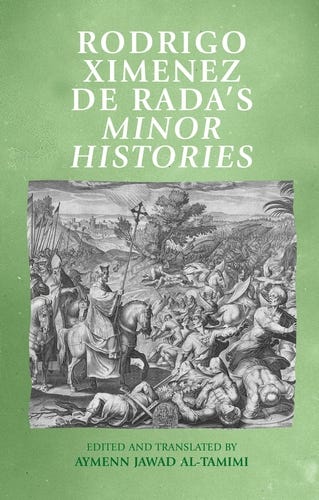
The translation of the ‘Minor Histories’, which is thoroughly annotated to provide context on locations, personalities, chronology, possible source materials and comparative source materials, includes a substantive introduction covering topics such as:
. Rodrigo’s life and career, including his involvement in ‘Crusades’ in the Iberian peninsula, his advocacy for the primacy of Toledo in the Iberian church hierarchy, and his relations with Toledo’s Jewish community.
. The nature of Rodrigo’s ‘History of Spain’ project.
. The negative portrayal of the Romans in the ‘Minor Histories.’
. Sources for the ‘Minor Histories’, focusing primarily on the ‘History of the Arabs’ and comparison of its material with surviving Arabic written sources.
. The question of whether oral traditions are a significant source of information in the ‘Minor Histories.’
. Whether and to what extent Rodrigo ‘knew’ Arabic and thus whether he could conduct independent research with Arabic source materials.
. Rodrigo’s understanding of Islam as a religion.
. The portrayal of Muslims and Arabs in Rodrigo’s writings, and what the ‘History of the Arabs’ in particular tells us about Rodrigo’s views on Muslim-Christian relations in Iberia, and what I would call ‘reverse dhimmitude’ (i.e. applying to Muslims the equivalence of the dhimmi status they imposed on Christians).
——————-
(Update 25 January 2026): For addenda and errata, see here.
Brilliant as the Iberian Peninsula and Toledo just beyond Andalusia retains so many visual legacies of this period.