Review: 'Jews vs Rome'
Two Centuries of Rebellion Against the World's Mightiest Empire
I have a new book review published in the Journal of the Middle East and Africa, reviewing Hoover Institution colleague Barry Strauss’ latest narrative history book: ‘Jews vs Rome’, which mainly focuses on Jewish unrest and rebellion against Roman authority and influence in the period 63 BCE-136 CE.
I reproduce the book review below.
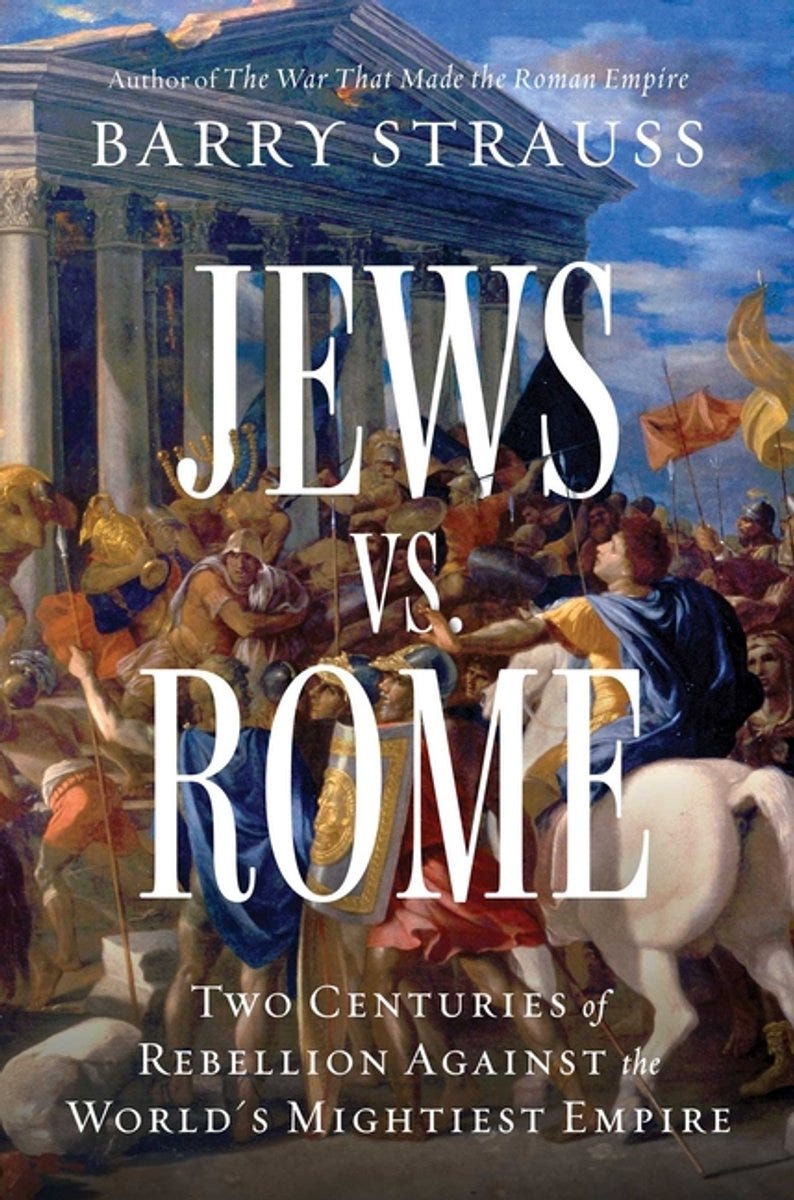
Over the course of Jewish history, the Jewish rebellions against Roman authority that primarily occurred in the first and second centuries CE must surely be counted as a decisive turning point in that they ended all notions of an independent or autonomous Jewish polity for nearly 2000 years. In his latest book, historian and Hoover Institution scholar Barry Strauss seeks to provide an accessible narrative history account that outlines the events of the rebellions and explains their motivations and consequences.
For his narrative, Strauss draws on a variety of sources. The most important ancient written sources for Strauss’s account are the works of Flavius Josephus, a Jewish notable who defected to the Roman side during the first major Jewish revolt, which primarily lasted from 66 to 70 CE when the Second Temple in Jerusalem was destroyed, though a group of rebels held out at Masada until 73 or 74 CE. Josephus effectively serves as the backbone for the majority of Strauss’s book embodied in the first nine chapters, which begin with Pompey’s conquest of Jerusalem in 63 BCE and the early years of a client kingdom in Judea and its environs through to the establishment of the province of Judea and finally the events of the first revolt and the defeat of the Jewish rebels at Masada.
However, Strauss is not simply regurgitating Josephus and is keen to remind us that despite the level of detail Josephus provides, he has his own agenda of defending his own career while also writing under Roman patronage and remaining emotionally attached to his people. Further, the statistics Josephus provides are generally not reliable, and like other ancient historians, purported speeches may be the product of inventio—a practice whereby the historian might have information about the gist of what someone said but then uses that to weave a more refined and elaborate discourse. Where possible, Strauss seeks to triangulate with other lines of evidence, such as the writings of the Roman historian Tacitus, Suetonius’s biographies of the emperors Vespasian and Titus (key figures in suppressing the first Jewish revolt), and archeological evidence, including examination of coins (numismatics).
Once Josephus can no longer be relied upon, the written source materials for the remaining subsequent incidents of Jewish revolt and unrest (namely, the so-called “Diaspora Revolt” dated to 116–117 CE and primarily occurring in Egypt, Cyrenaica, Judea, and Cyprus, and the Bar Kokhba revolt in Judea in the 130s CE) become much more fragmentary and tend to date well after the events described. A brief epilogue note first describes the “Gallus Revolt” of the mid-fourth century CE, which is named for Constantius Gallus (ruling the Roman east at the time) but is not documented in Jewish sources and was likely on a much smaller scale than prior unrest. It then notes the Jews’ uneasy position between the Byzantines and Sassanids in the seventh century CE before the arrival of the Muslim conquerors.
In conclusion, Strauss asks what motivated Jews to rebel frequently and “what made them different from other peoples of the empire.” As Strauss notes, revolt itself was hardly unique to Jews under the Roman Empire. For example, in Roman Africa (modern-day Tunisia and its environs), Tacfarinas engaged in a prolonged insurgency against the Romans during the reign of the Emperor Tiberius. What made the Jewish revolts stand out was a desire to achieve an independent or at least autonomous Jewish polity – a polity defined by submission to God’s law and the centrality of the Temple, not, as Strauss correctly notes earlier in the book, a Greek notion of “freedom” in the sense of popular participation in politics. This clarification is an important nuance and reminder that concepts of liberty have different meanings for different people.
More broadly, Jewish monotheism was difficult to reconcile with Roman polytheism, which could be readily adapted by, say, Greek polytheism, with Roman deities like Jupiter and Mars becoming the equivalents of Zeus and Ares, respectively. Additional motivating factors for revolts were trends of apocalypticism and messianic expectation among the Jews. Ultimately, however, the devastating losses that the failed revolts brought about for the Jewish community led Jewish religious leadership to conclude that the Jews had to adapt to the reality of Roman rule, while not abandoning hope in an eventual redemption and the coming of the Messiah. Indeed, until the advent of modern Zionism, Jewish adaptation to the existing non-Jewish authorities, wherever they were, was very much the norm.
In general, Strauss has produced a highly readable account that is accessible to the lay reader and can also be perused by the specialist. It is up to date with the existing scholarship on the topic (which Strauss engages with and does not simply disregard as though he were the first person to write on this topic). Overall, his conclusions and analysis – both at the broader and specific level – are reasonable. Strauss highlights that while the Jewish rebels may be admired for their daring, the revolts were also “murderous and deluded,” devoid of strategic realism. Further, the story was not simply one of the Jews vs. Rome, but also a “Jewish civil war,” especially during the first major revolt.
For all these merits, there are some paragraphs and sections that lack source citation, with the result being that it is not immediately clear to the reader where Strauss is getting his information. Further, a few comparisons he makes will not be understandable to the general reader, such as when he writes: “The Diaspora Revolt also features strategic acumen on the ice-cold level of Richelieu or Bismarck.”
But on a wider level, Strauss’s attempt to establish the relevance of his historical account to today’s world and events seems underdeveloped and unconvincing. Unlike Judea and its position between Rome and Parthia, Israel today is not a weak state caught between two mighty empires or blocs. Rather, despite its small size, Israel is one of the leading military powers within the Middle East, possessing great advantages in firepower, technology, and intelligence gathering over its most implacable enemies (principally the Iranian-led “axis of resistance” and Sunni Salafi jihadists, both of which have now been greatly weakened). In the very opening of his work, Strauss writes: “It is my hope that the history of this period, these people and these struggles, will offer context for the clash of civilizations we are witnessing today and forge a deeper understanding of the forces that propel them.” But Strauss never clearly defines the nature of the “clash of civilizations” or explains how it connects to this ancient history. Consequently, while his book offers a compelling narrative account of the Jewish revolts against Rome, he does not adequately demonstrate its relevance or applicability to our present day.


