

Over the past few days, fighting has arisen in Aleppo city between Syrian government forces and forces affiliated with the Kurdish-led Syrian Democratic Forces’ ‘Autonomous Administration’ stationed in the neighbourhoods of Shaykh Maqsud and Ashrafiya. Even from the distance in the Aleppo countryside at around 20 kilometres to the north, the sound of bombing and exchange of fire has been noticeable to locals. What is motivating the fighting and what is the likely outcome? Below are a couple of key observations.
(i) The latest escalation began with an exchange of accusations between the two sides about breaking a ceasefire agreement. Understandably, some of the commentary focuses on trying to determine which side actually initiated the hostilities on this occasion, and certainly that is a question worthy of research for the historical record. But I think that analytically speaking, this focus is somewhat misdirected. The conflict here is ultimately a miniaturised version of the broader problem between the central government and the SDF: that is, the two sides have fundamentally incompatible political visions.
The central government aspires to a ‘unified’ Syria with centralised governance and rejects of notions of ‘federalism.’ This vision partly reflects long-standing suspicion of notions of ‘federalism’ as amounting to ‘partition’ of Syria, but also the tendencies of the former Hay’at Tahrir al-Sham figures who lead the central government and previously established a governing entity in Idlib and its environs that did not allow for rival political projects. The SDF’s vision is one of ‘federalism’, which in practice translates to a desire for the central government to grant formal recognition of its political project embodied in the ‘autonomous administration’ and the autonomous structure of the SDF’s forces.
All the discussions and talk of implementing the ‘10 March’ agreement between the two sides (which talks of integrating the SDF into the Syrian state and was skewed towards the central government’s standpoint) have failed to produce meaningful progress because of an inability to bridge this fundamental divide. This should be recognised regardless of which side an observer sympathises with. In recent weeks, commentators and sources on both sides have ‘leaked’ various details to media outlets about specific points of discussion in the negotiations, but it is clear that none of the specific offers or counter-offers by the two sides have managed to overcome the aforementioned divide.
With all this borne in mind, it should be clear that even if the current round of fighting leads to another ceasefire (though this time, from the assets deployed, the government seems to be making a concerted effort to seize Shaykh Maqsud and Ashrafiya), it has long been a matter of when the government would seek to take full control of the neighbourhoods, and not if. Indeed, even prior to the latest fighting, some government supporters spoke of an inevitably coming battle to ‘recover’ Shaykh Maqsud and Ashrafiya from SDF ‘occupation.’ Some even go so far as to deny that the two neighbourhoods have a connection with Kurdish identity. For example, here is Omar al-Hasan, who served as an independent MP for the Syrian parliament under the Assad regime and was supported by the Iranian-backed Baqir Brigade, which notably defected and whose networks are now firmly behind the new government:
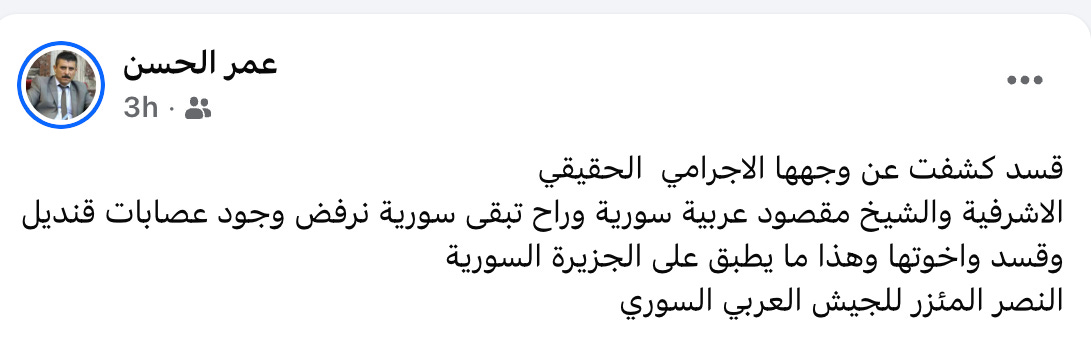
"The SDF has revealed its true criminal face. Ashrafiya and Shaykh Maqsud are Syrian Arab, and will remain Syrian. We reject the existence of the Qandil [PKK] and SDF gangs and their sisters, and this also applies to the Syrian Jazira [northeast]. Definitive victory to the Syrian Arab Army."
If negotiations could not produce the central government’s desired outcome, what would prevent it from eventually utilising force in some way to achieve its goal?
(ii) Related to the first point is the imbalance of military capabilities between the two sides. Part of the reason why the government likely seeks to impose a solution by force is because it feels that it can do so. The government has a large firepower and manpower advantage versus the SDF forces that are virtually besieged and generally only bear light arms. In light of this imbalance, it is logical to expect that without a ceasefire agreement that halts the fighting and freezes the frontlines, or some kind of external military intervention on the SDF’s behalf, the outcome will be a central government takeover of Shaykh Maqsud and Ashrafiya. Further, the government likely draws confidence from the past record of all-out, sustained confrontations between opposition forces and the SDF, with the former consistently winning in Afrin and its environs, Tel Abyad and Ras al-Ayn. Of course, on those occasions, the opposition forces also had Turkish military support, but the broader point about a manpower and firepower imbalance still applies.
A success for the government in Shaykh Maqsud and Ashrafiya is also likely to influence its approach towards the SDF in Arab majority areas of Raqqa and Dayr al-Zur provinces should negotiations continue to fail in producing real progress. It is plausible that the government will calculate that sustained military pressure- and not mere skirmishes- can succeed in wresting control of these areas from the SDF.