

It has been around a year since Syrian government forces and allied tribal militiamen entered the primarily Druze province of al-Suwayda’ in southern Syria, ostensibly serving as a ‘mediation’ force but in fact seeking to impose government security control and dismantle the Druze armed groups in the province that were largely responsible for security. The government campaign saw massacres and other violations committed against the Druze community, with violations being committed on a much smaller scale by Druze armed groups against Bedouins who left the province.
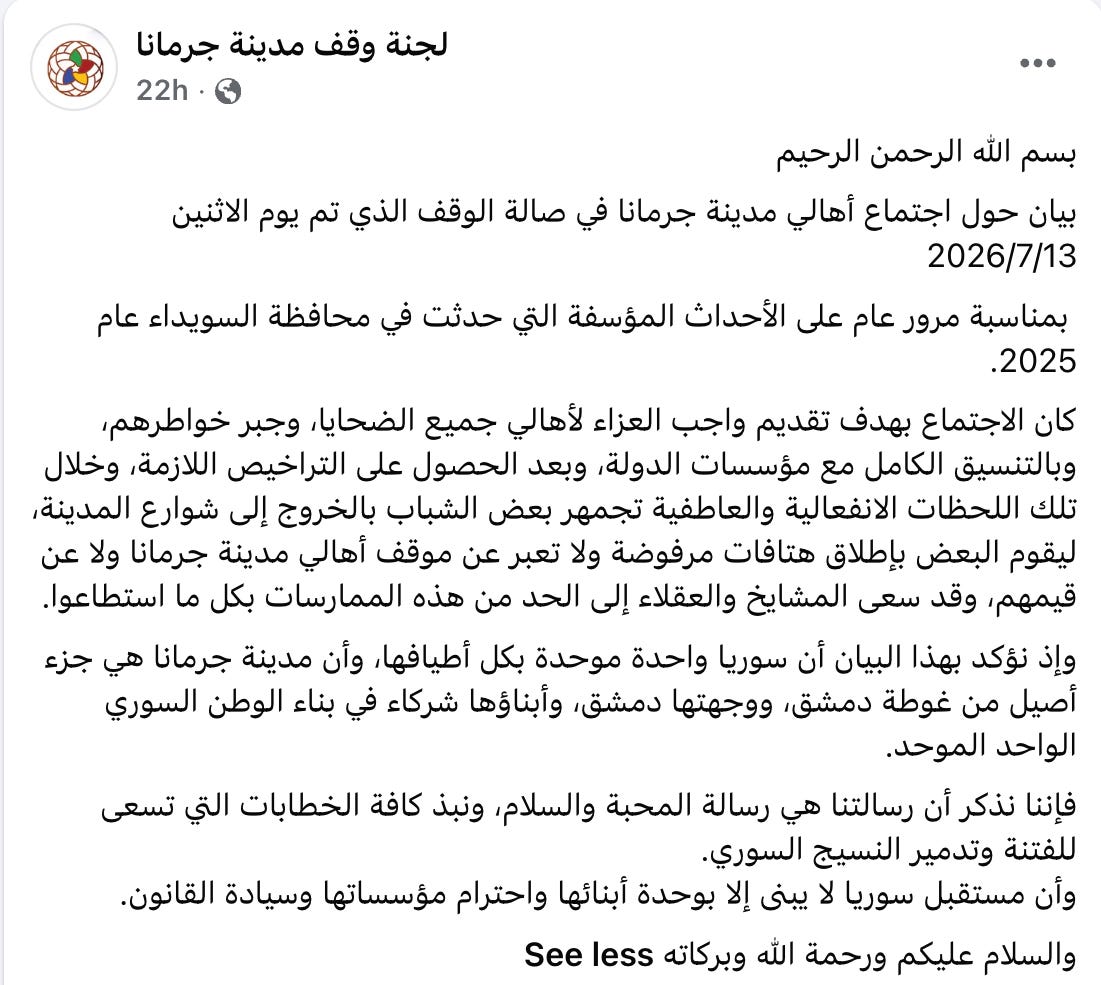
Understandably, the anniversary of the massacres has seen commemorations in remembrance of the victims among Druze communities in the region and in the West. In some cases, grief over the massacres has spilled into denunciations of the Syrian government: most notably in the Damascus suburb of Jaramana that contains a large Druze population and was brought under government control in May of last year. The controversy over the denunciations and reported declarations of support for Suwayda’ Druze religious leader Hikmat al-Hijri and the ‘Mount Bashan’ separatist project prompted the Druze Jaramana Waqf Committee to issue a clarification statement, stating that the authorities had granted permission for demonstrations in remembrance of the victims of the massacres but then ‘some youth’ took the opportunity to express ‘rejected chants that do not express the stance of the people of the town of Jaramana or their values.’ The statement (see below) affirmed support for ‘a one unified Syria in all its sects, and the town of Jaramana is an authentic part of Ghouta in Damascus, and its orientation is Damascus, and its people are partners in building one unified Syrian homeland.’ This positioning by Druze religious authorities in Jaramana is unsurprising, considering that Jaramana’s Druze population constitutes an isolated community and is at the mercy of the government authorities.
As for the Druze of Suwayda’, the predominant public stance remains one of open rejection towards the government, which is seen as not having done much beyond symbolic measures for accountability (e.g. the recent sessions for public trial of a limited number of defendants, whose names and images are not publicised in media) and having sought to deflect from accountability by focusing on portraying Hikmat al-Hijri and his supporters as the real villains.
However, a rejectionist stance towards the government does not mean total unity of position and opinion in Suwayda’.