

Discussion of the availability of electricity in Syria often involves a macroview of statistics about power supply and consumption. While big picture statistics are useful, they may obscure the nature and variety of practical experience on the ground with regards to availability, sources and costs of electricity. I can also see that some commentators outside Syria have a grossly distorted sense of the electricity situation on the ground. In this post I will focus on my own experiences with electricity in Syria to give a sense of contrasts.
The Shia village of Nubl in north Aleppo countryside was controlled by the Assad regime prior to its collapse in December last year. As of the time of writing, there is generally no state electricity in the village. There is a transformer in the village that was installed by the Iranians and supplied state electricity from Aleppo’s industrial city in 2019, but it is not in operation right now, and even when it was in operation it only supplied around two hours of state electricity by day and two hours by night in the best of circumstances. At night, it is noticeable how dark the streets are because of lack of street lighting from state electricity.
Thus, for years, the inhabitants have primarily relied on privately-owned diesel generators, which provide reliable electricity to meet domestic needs but are in fact very costly. The electricity from the generators is priced by kilowatt hours (kWh) and billed every week. Owing to the changing value of the Syrian pound against dollar (with recent months pointing to a steady decline in value to just under 12000 Syrian pounds against the dollar as of the time of writing), the price of electricity from the generators is currently 12000 Syrian pounds per kWh, having risen from 10000 Syrian pounds per kWh just a few months ago. In other words, the price of a kWh is kept constant at around $1. Compare statistics about household electricity consumption and prices per kWh from other countries, and it quickly becomes apparent how expensive electricity from generators is here: for example, the rate is nearly three times the average cost of electricity per kwH in the UK.
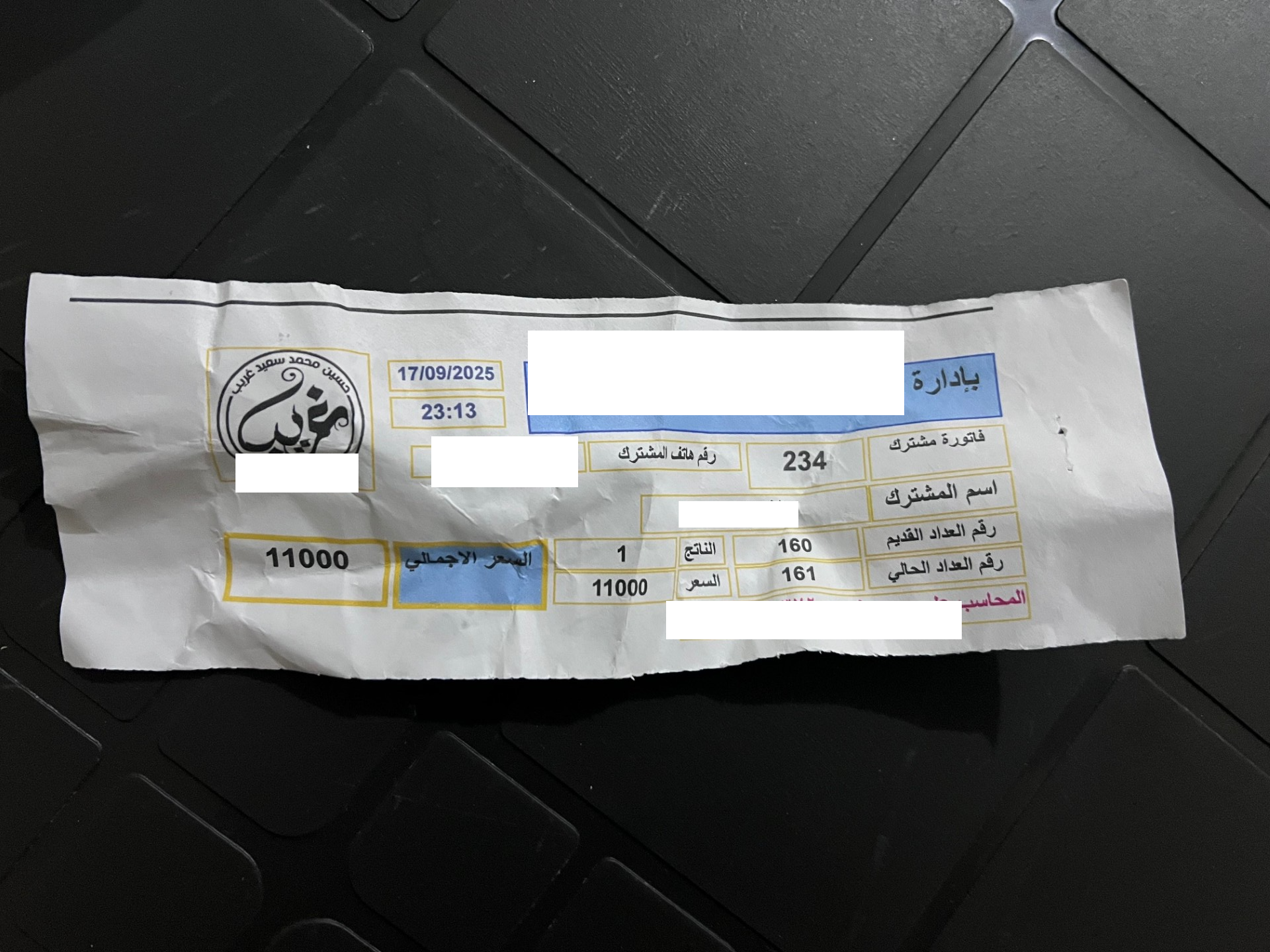
A weekly electricity bill from a private generator company, dated 17 September 2025. The consumption of 1 kWh here amounts to a bill of 11000 Syrian pounds.
Of course, most households in Nubl do not consume as much electricity as an average UK household, but limited incomes that often amount to little more than $200 per month mean that for those who cannot afford to install alternative sources of electricity, careful discretion has to be exercised as to what appliances can be used and for how long. For many residents, the use of a refrigerator is likely to make a key difference to electricity bills, with 24/7 usage likely to bring an electricity bill into the range of $20-30 a week. This rate is prohibitively expensive for many residents, and as a result there is a widespread preference for turning off the refrigerator at night, despite the risks this may pose for proper and safe storage of food.
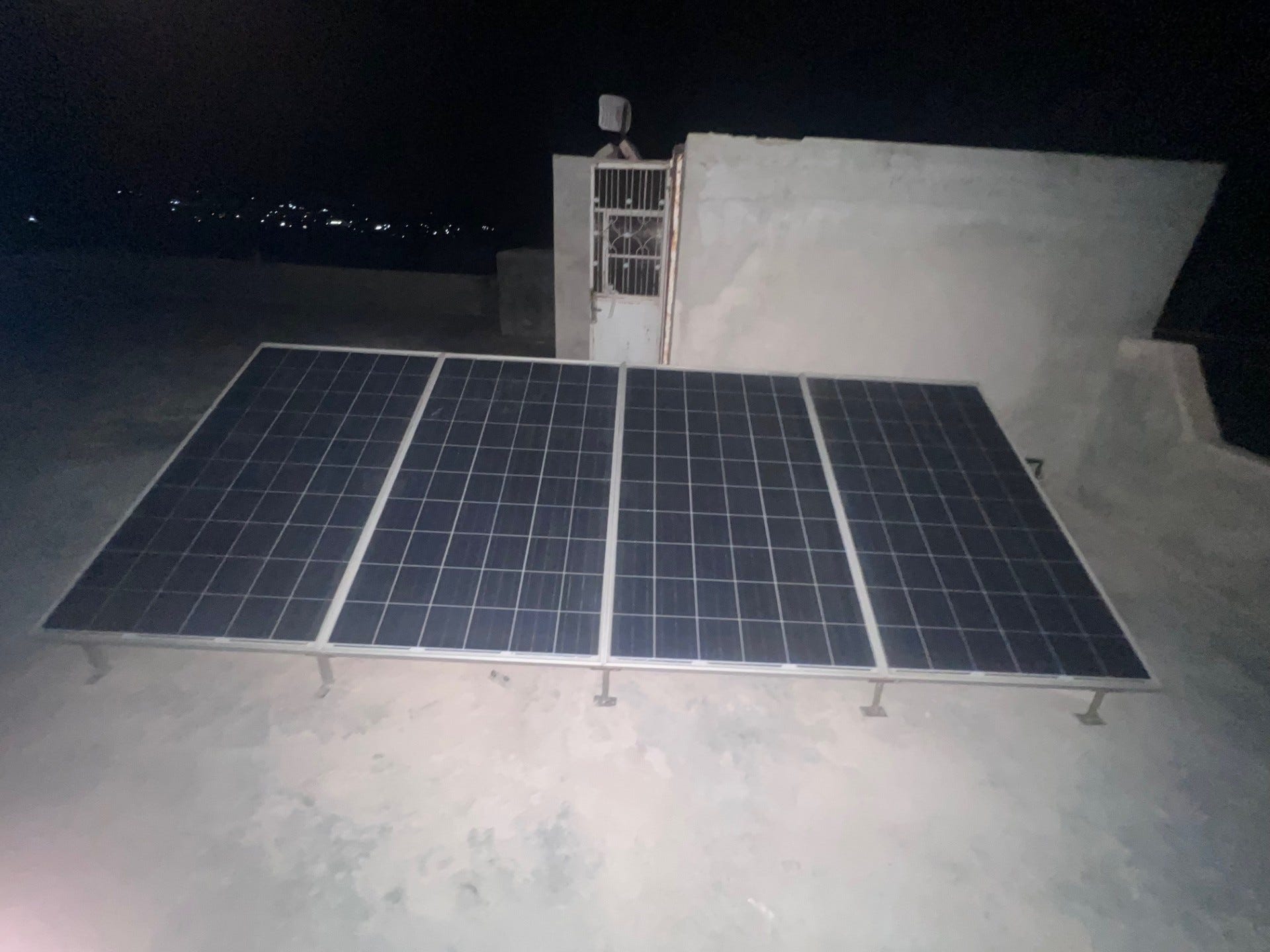
The primary alternative in Nubl to reliance on generators is solar power in the form of panels connected to a battery or multiple batteries. To give a practical example, the four panels below, installed on a house rooftop in Nubl for a few hundred dollars, operate two batteries supplying electricity to a home. On a typical summer day (with plenty of sunshine as there is no rainfall during the summer months), the electricity supplied can potentially charge laptops and smartphones, operate lights in the home, operate a wifi router and keep a fridge running 24/7. In practice however, the solar power will more likely keep things running for anywhere between 12-22 hours depending on usage of other appliances such as a washing machine and an electric vacuum cleaner. As such, some usage of electricity from the private generators is likely inevitable in a given week, but with a dramatic cut in costs to as little as $1-2 per week. Thus, solar power serves not only as a clean, environmentally friendly alternative, but also an effective means of cutting costs while maintaining a generally reliable supply of electricity.
Only a little further north of Nubl along the Turkish border, matters for electricity are rather different. For example, in Azaz, which had long been controlled by factions of the Turkish-backed ‘Syrian National Army’ prior to the collapse of the Assad regime, there has been a long-standing connection with the Turkish electricity network. This has largely eliminated reliance on private generators, and solar power is not so widely used as an alternative. In Azaz, consumers can buy set ‘packages’ of electricity, such as 40 kWh at a price of 200 Turkish liras (the Turkish lira remaining the predominant currency used in Azaz despite the transition), as per the receipt below. Taking into account the exchange rate, the cost of electricity per kWh is around eight times cheaper than the generators in Nubl.
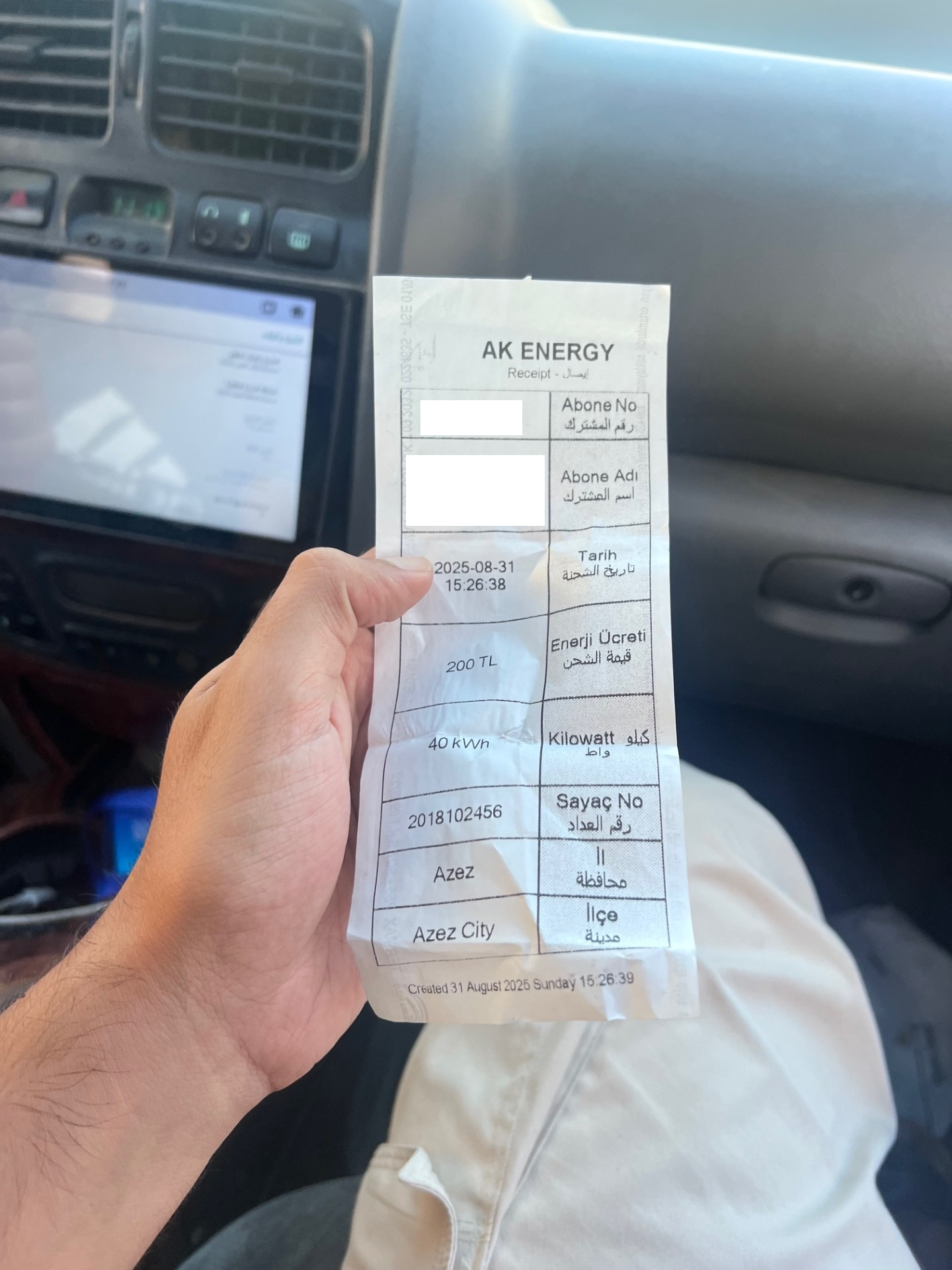
Receipt from Azaz dated 31 August 2025 for the purchase of 40 kWh from Syrian-Turkish-German company AK Energy (which works to supply Turkish electricity to Azaz and other towns in north Aleppo countryside).
At present, there are rumours of plans to expand supply via the Turkish grid to villages nearer Aleppo city, including Nubl. However, it is not yet clear if or when this will actually be carried out, with some claims that the connection will be completed by early next year.
It is to be hoped that with the rebuilding and expansion of Syria’s electricity network, solar power in particular can play a prominent role. Not only is it a clean form of energy as opposed to diesel generators, but it is also well suited to much of Syria’s climate.
[Update 3 November: amid reports that an electricity pylon that connects Nubl and al-Zahara’ to state electricity was sabotaged, it should be clarified that the impact on electricity within residential homes is minimal, but some service institutions are impacted. For instance, some state electricity is used for pumping water from the state network. It has not led to a complete cut-off of drinking water as has been claimed however, because there are also private trucks that deliver water to many homes, and for those who have subscriptions to state water, the water comes at specific times of the week for homes in different parts of the towns, during which the residents use pumps to fill the tanks in their homes. However, with disruption to extraction from state-owned wells, prices for trucks of water have gone up.
A local Nubl news page, ‘Siriya al-Ilamiya’, clarifies:
"It should be noted that Nubl [power] station, since the liberation,* does not supply residential areas, with the supply being limited to power the water wells and official service offices in the town of Nubl and al-Zahara’, and there are efforts being made to designate one of the station’s outflows to power the water wells in the neighbouring locality of Mayer"
*- This is because the Iranian-supplied transformer is no longer in operation].
So this recent downing of an electrical pylon has no real effect?
What about Damascus itself--and its suburbs?