

The term ‘Moriscos’ refers to Muslims who remained in Spain after the Christian capture of Granada in 1492 CE and were subsequently given the choice of conversion to Christianity or exile and thus outwardly converted to Christianity. While some converted and became sincere in their adoption of their new faith, the private practice of Islam continued to endure among many others. It is this sort of ‘crypto-Islam’ that can be seen as a form of taqiyya in the sense of dissimulation to prevent persecution and harm.
In an interesting recent article published in al-Quds al-Arabi, Nour Kourko- a Syrian writer- compares the situation of the Moriscos with communities in Iraq and Syria that outwardly showed the practice of Sunni Islam under coercion and pressure from jihadists in recent times: most notably, the Shi‘a of Mosul who were unable to flee during the Islamic State’s rule there (2014-2017), and the Druze community of the Jabal al-Summaq region of northern Idlib, which still outwardly professes Sunni Islam, having declared conversion twice, first under Islamic State and then Jabhat al-Nusra.
I have translated the article in full below.
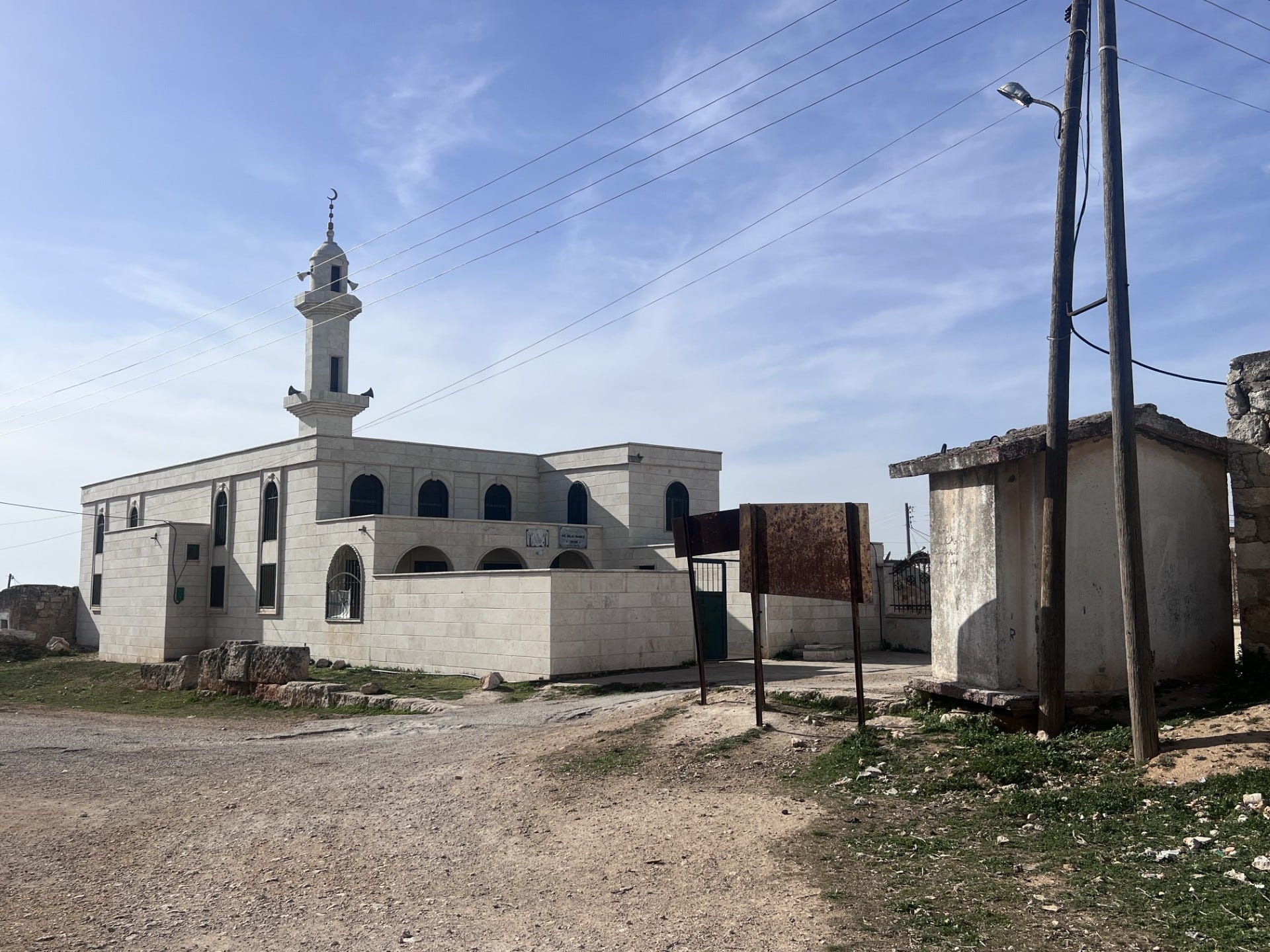
The Bilal al-Habashi mosque in the originally Druze village of Qalb Lawze in the Jabal al-Summaq area, north Idlib countryside (March 2025, photo my own). The mosque was built with Turkish support.
Between the Moriscos of Yesterday and Today: Taqiyya as an Option to Stay Alive
By Nour Kourko
Granada fell but it remained a source of agony in the throat of all those who believed the promises and covenants that were burned with the fire of extremism. Those who could leave departed, while those who clung to their land and the poor remained trapped in purgatory, whereby they distinguished between their internal Islam and their outward Christianity. The Moriscos are the story of a people who did not submit despite the psychological torment, fear and threats in every moment of execution by burning if their ‘heresy’ was uncovered, for they are the Muslims of Granada who did not leave after it fell.
How, why, and where were the other Muslims to save them at that time? I used to disbelieve the saying ‘history repeats itself’ until I saw history repeated in all countries, and saw the Moriscos’ descendants in the eyes of the oppressed today, regardless of their identity and ethnicity. It is a given that when civilisations grow weak, their enemies become numerous and surrender becomes easy amid fear of more bloodshed. But no one knows the fate of those who wished to stay. For the rulers imposed Christianity on all the Muslims there as well as complete renunciation of their religion, placing them under intense scrutiny, such that even using the bathroom on Friday was considered a violation, while the one speaking in the mother tongue of Arabic would merit torture and execution if that person’s adherence to Islam were proven. And so this people had no choice but to engage in taqiyya, for they were Muslims in their homes and Christians outside them. They would go to churches and practise rituals and buy pork but only so that it should serve as camouflage, with its scent emanating from their homes, without the meat being eaten. Amid all these events, a hidden soldier cleverly preserves the splendour of Islam without attracting the attention of the soldiers deployed in Granada’s alleys. This soldier is the Morisco woman who devised many schemes to keep the torture away from her home and preserve her mosque in the house. She is the one who lit the fire so that the scent of pig’s fat should emanate while she would be cooking halal food in another pot she carefully covered.
She raised the generations on the creeds and Shari’a and warned the child that his name outside the home would be ‘José’ and ‘Yusuf’ inside it, and that he should not reveal to anyone what they were doing inside their home. She preserved the water so that only a small amount of it would remain, sufficient for ablution, lest the people in charge should realise that they were practising their rituals. She would clothe her children with new clothes on Eid, concealed under ordinary clothes. Even the joy had to be concealed. The sacrificial animals had to be secretly slaughtered with a barely audible Bismillah. All this was happening while the Muslims at the time were preoccupied with their own countries and problems, even as some of them tried to offer aid.
Man can conceal the truth about everything, but if he conceals his language, the last ounce of his identity and civilisation will be wiped out. This is what the Moriscos sought to prevent. They made a new language called ‘Aljamiado’, which is writing Spanish in Arabic letters, so that they could preserve their history and Islam. When they were displaced from Granada, the women placed these manuscripts in their children’s cradles and inside their clothes, lest they should be destroyed, and so that their heritage should be preserved as far as possible through the generations. One such woman was the wise Mariam, that lady who was mentioned in the inquisition courts’ records as ‘Maria de Luna’ when investigators raided her home in 1588. They did not find weapons but a Noble Qur’an hidden under the stove’s tiling. Mariam steadfastly faced torture and boldly told the interrogator: ‘I did it because it is my mother’s heritage. We sanctify our forefathers’ heritage just as you sanctify the remains of saints.’[1] Thus did Mariam protect the spirit of an entire nation from erasure. Despite the Christians’ extreme position that the original Christian had to be pure blood without being contaminated with other religions, and their expulsion of thousands of Moriscos to North Africa, they failed to extirpate the roots that extended to Morocco, Tunisia and Algeria. And the genes did not die out in al-Andalus.
This story is a stark reminder that repression may change the features of the streets, but it will never wash away the water of ablution from people’s memory. Mariam passed away, but her secret prayer is still repeated in the Ma’luf songs and fragrance of Andalusian jasmine. But what about the Moriscos of today? Who are they and where do they live? When I said that history repeats itself, I meant we have witnessed today those who have concealed their religion in fear of torment, as was the case in Iraq’s Mosul, where the remaining Shia hid their sect out of fear of Daesh’s repression of them. So they outwardly showed they were adherents of another sect in order to prevent themselves from being killed on the pretext of disbelief and apostasy. There is also a region in Idlib called Jabal al-Summaq: a group of inhabitants who are originally Druze, but they abandoned their sect, first under pressure from Daesh whereby they announced their conversion to Islam. Then the Tunisian amir for Jabhat al-Nusra in the area came to undertake the role of inquisitor of doctrine, and thus he asked them to prove their Islam. And so they destroyed their shrines and obeyed to protect themselves. The Bilal al-Habashi mosque remains, as does the voice of the muezzin from among the original inhabitants, and the children ask: Are we Druze or Muslims?
Are they right to practise taqiyya? Yes, they are right. Because the minority has to assimilate to the majority, in order to prevent tribulations and bloodshed, even if the land, despite its vastness, is narrow for them and prevents them from practising their rituals in which they found tranquillity and closeness to God. Taqiyya is the ideal solution for patience and preventing the land from being torn up for the sake of extreme partisanship, and the sound hearts can find and know God and preserve their religion just as Mariam did with the Qur’an and Aljamiado manuscripts, seemingly drawing the map of an entire generation with pen, paper and words that cannot be erased, not matter how much they remain under tiling and not matter how much the persecutors try to erase them from memory.
Notes
[1] Some literary license here, but examples of Moriscos hiding copies of Qur’ans and being distressed by their confiscation are well attested.
I very much appreciate the research and writing Dr. Tamimi is sharing on Substack. Shokran, ustedh! Anta mithla al-Najd.
Understanding Andalus gives us a better picture of not only Muslim Spain (al-Andalus) and 1492 (Reconquest Spain), but the making of the Modern World. Through the Spanish Conquest of the Americas followed by centuries of European Colonialism, the Mediterranean World System became the Modern World System. That is why the preferences and prejudices of the Modern World reflect those people; it's where they terms "West" and "East" come from, they refer primarily to the division between the western and eastern Mediterranean, which divided between Christian Europe and Muslim Middle East during the Middle Ages. The implications are meaningful. The Europeans and the Arabs are simply two different clans from the same pan-Mediterranean tribe of people, the Monotheistic people. The Mediterranean world was a Monotheistic world system brought together with other notions concerning property rights and government, which were modified over time to suit the desire to possess land and extract its resources, a system of economics the Europeans would perfect in the Americas. It was this process that created the modern political economy we live in today.
Even though many people understand the Spanish exploration of the Americas, they have little understanding what the Catholics of Aragon did in Reconquest Spain, and the syncretic world of al-Andalus the Catholics tried to erase. Zionists and Evangelicals today both actively try to subvert an understanding of this history, because it flies in the face of any form of national religious supremacy from any of the Monotheistic religions; and, let's be honest, it is only among the Monotheists that we find doctrines of national religious supremacy. "The God whose name is Jealous, is a jealous God." Exodus 34:14. The same could be said of the sovereign. It would not be until 1648 in the Treaty of Westphalia that the notion of God-King-Sovereign would become People-King-Sovereign, and later, People-Democracy-Sovereign. It's only in recent times that some white nationalist supremacists espousing Evangelicalism or Zionism tried to put their God back in the mix like it was 1492 all over again. Now Americans must pretend to be Zionist or be attacked by their own democratic institutions as "anti-Semitic." An American taqqiya. It's a wrong-headed view that a real understanding of al-Andalus and Reconquest Spain straightens out.
The Umayyads of Syria united the Mediterranean World that was over 60% Christian and Sephardi for roughly 300 years -- 810 to 1010 AD. Though the Umayyads came and went, Andalus existed for over 750 years until 1492. The Latinized Spanish Catholics of Aragon (northern Spain) were religious supremacists who expelled, first, the Sephardi, and when the Muslims resisted the treatment of their fellow Andalusians, the Catholics expelled them too. The Sephardi went north into Europe, where they became the Ashkenazi, the "Northerners." Muslims either left to North Africa, or stayed and converted or pretended to convert. The Moriscos, quasi-Moors. For an account of the Muslims leaving Spain read Amin Maalouf's Leo Africanus, a great historical novel from 1488 to 1527.
The other non-Catholic group that stayed in Reconquest Spain was the Mozarabs, the Byzantine Christians from Umayyad Syria. They still exist in small numbers in the Castilian region. They would have blended in with the Catholics, or pretended to convert like the Moriscos.
I have done research into whether any Moriscos or Mozarabs joined the Spanish Conquest of the Americas, as they surely would have done despite the decree forbidding any non-Catholics to travel there (Requerimiento of 1513). There is at least one account by the Hopi researchers where "a Moor named Estevan" offended a Zuni Pueblo Indian and was killed. It is a very interesting account in the recently published two-volume series Moquis & Kastiilam. The Spanish called the Hopi "Moquis" Indians, the Hopi called the Spanish, Kastiilam, the Castilians.
How could a Hopi differentiate between the Castilians? Surely, they could not. All Castilians looked alike to a Hopi in 1540, which is very telling. Who were the Castilians telling these people to obey their One God? Surely, they were all the same Mediterranean wackadoodles? Right? Look at it from the other point of view -- these were Mediterranean people demanding other people obey their One God, whether they were Catholic, Muslim, or Sephardic. Seen from outside their own bubble, the Europeans, Arabs, and North Africans are the same tribe of Monotheists.
So who did the Hopi encounter when they encountered the Spanish for the first time in the 1530s? They encountered the Conversos. The people who were subjected to the Spanish Inquisition and converted under pain of torture, death, or exile. It was the Conversos who came to the Americas, which makes a lot of sense since they were so conversion-oriented. In other words, what the Spanish Catholics did in America they first did in Muslim Spain.
The second encounter of the Hopi and the Castilians involved the Salt Trail, where a group of Hopi accompanied 12 members of Coronado's expedition who wanted to map the Grand Canyon, and they brought them to the bottom of the Grand Canyon. Only the Hopi knew the way in and out of the Grand Canyon, they took what they called the Salt Trail. It has a double-meaning to the Hopi. The Salt Trail was real in that it was a trail that led to the Salt Flats where the Hopi collected salt. It also meant a "journey to Maski," the underworld. The Hopi left all 12 members of the expedition at the bottom of the Grand Canyon, expecting them to die there. They took them to Maski, not to the Salt Flats, which were sacred to the Hopi. (Sacred, meaning salt and water they did not want to share with other people, not necessarily holy.) Only one of the map making expedition made it out of the Grand Canyon, the leader Juan de Castenada, Francisco DeTovar's maestre de campo. He made it back to Santa Fe. He complained about the tricks played by the "Mokweh Injins." Castenada returned to Spain, where he was the only person convicted for crimes against indigenous people by the Coronado Expedition. All because of the Salt Trail trick played by the Hopi. "Mokweh juegos," the Spanish Inquisitors notes read. "Indian games." They sentenced him to never leave Spain again. He lived out his life in Malaga.
In 1680, the Pueblos revolted across the Rio Grande, destroyed the Missions, and beat the Spanish back into Mexico.
In 1700, the Franciscans returned to the village of Awatovi, and the Hopi burned down the village with every one in it, Franciscan and Hopi alike. The Arrowhead Clan was exterminated. Awatovi is now a mass grave site. The Spanish did not return to the Three Mesas.
In 1906, the Hopi split between the Hostiles and the Friendlies -- those who wanted to send their kids to American school (the Friendlies, or Progressives) and those who did not (the Hostiles, or Conservatives). American education split the Hopi, not the Spanish.
Dear Dr al-Tamimi,
I read your articles on the Moriscos with great interest. It took me back to a book by the great scholar ,Henry Charles Lea, about the Moriscos read many years ago.
As a Professor of Holocaust and AntiSemitism with the City University of NY, I always felt that the Christian persecution of both Jews and Muslims in Andalusia could have been that link bringing Jews and Muslims together to research and study the end of religious tolerance in Spain from the 14th through 17th centuries. Alas, for missed opportunities.
Yours truly,
Dr Richard Tomback