

Thanks to Virgil’s epic the Aeneid, the story of the wanderings of Aeneas from Troy to Italy following Troy’s destruction by the Greeks became well-known and established as Rome’s founding myth. The transmission of the Aeneid continued into the Middle Ages, but there were also other Latin works studied and disseminated as part of understanding the history of Troy and Rome’s earliest foundations. One work in this latter category is the Excidium Troie (‘Destruction of Troy’), which primarily focuses on Aeneas’ wanderings and final settlement in Italy. In turn, the Excidium Troie could be subject to abbreviation and paraphrase.
The following post presents a translation and overview of one such abbreviation and paraphrase of the Excidium Troie that ultimately appears to go back to southern Italy in the 10th century CE, forming part of what its editor Marek Kretschmer calls a ‘historical miscellany…conceived as a continuous universal history determined by the idea of translatio imperii’ (i.e. the transfer of worldly power from one nation to another). In this case, the paraphrase of the Excidium is paired with Paul the Deacon’s Roman History.
The most striking feature is the way that the paraphrase attempts to ‘demythologise’ the story as far as possible. Thus, in explaining the origins of the Trojan War (only a minor part of the narrative), the paraphrase stresses that figures like Jupiter, Neptune and Apollo were ‘called gods’. In detailing Aeneas’ wanderings and settlement in Italy, the divine element that is to be found in the Aeneid is expunged entirely. For example, in the Aeneid, the goddess Juno (counterpart to the Greek goddess Hera) is a divine antagonist of Aeneas, thwarting his initial attempt to reach Italy and supporting the Italian prince Turnus once Aeneas arrives in Italy. Likewise, messages from gods and prophets are replaced with impersonal phrasing about something appearing to Aeneas in a dream and communicating a message.
This paraphrase of the Excidium Troie is also significant because it is likely the backbone source for Toledan archbishop Rodrigo Ximénez de Rada’s (d. 1247 CE) narrative of Aeneas’ wanderings and settlement in Italy in his Historia Romanorum (‘History of the Romans’), the first supplemental volume to his history of Spain project. The connection was spotted by Helena de Carlos Villamarín in 2019 (which I had not noticed in my translation and commentary on the Historia Romanorum as part of my study of Rodrigo’s Minor Histories). Although Rodrigo knew the Aeneid and made use of it and Ovid’s work in his narrative of Aeneas (a story he considers to have taken place in the real light of history minus the role of Graeco-Roman deities, just as many medieval authors did), there are multiple parallels in both content and phrasing that point to his use of the paraphrase as the foundational source, most notably:
(i) Palinurus dies in a storm before Aeneas and his fleet reach Africa.
(ii) Aeneas being told in a dream he will first marry Dido and then go to Italy, as well as the notion that the two were actually married.
(iii) A factor driving Dido of Carthage to fall in love with Aeneas is his appearance in his arms of war.
(iv) Aeneas being told in a dream, after his arrival in Italy, that he will find a white pig with 30 offspring under an oak-tree.
(v) A specific note that in ancient times, peace was signified by carrying an olive branch.
(vi) The sequence of events for the deaths of Mezentius and his son Lausus.
(vii) An escort of 100 men to console Aeneas’ ally Evander on the death of his son Pallas.
(viii) Diomedes’ explanation for rejecting King Latinus’ petition to provide him help against Aeneas.
An innovation on Rodrigo’s part, however, is that he has Aeneas leave Carthage because he considers the depiction of the story of Troy at Carthage to be something shameful. It is possible that he became aware of the paraphrase of Excidium Troie and Paul the Deacon’s Roman History (which he also used as a source of the Historia Romanorum) through his visits to Italy.
Below is the paraphrase of Excidium Troie fully translated and annotated by me.
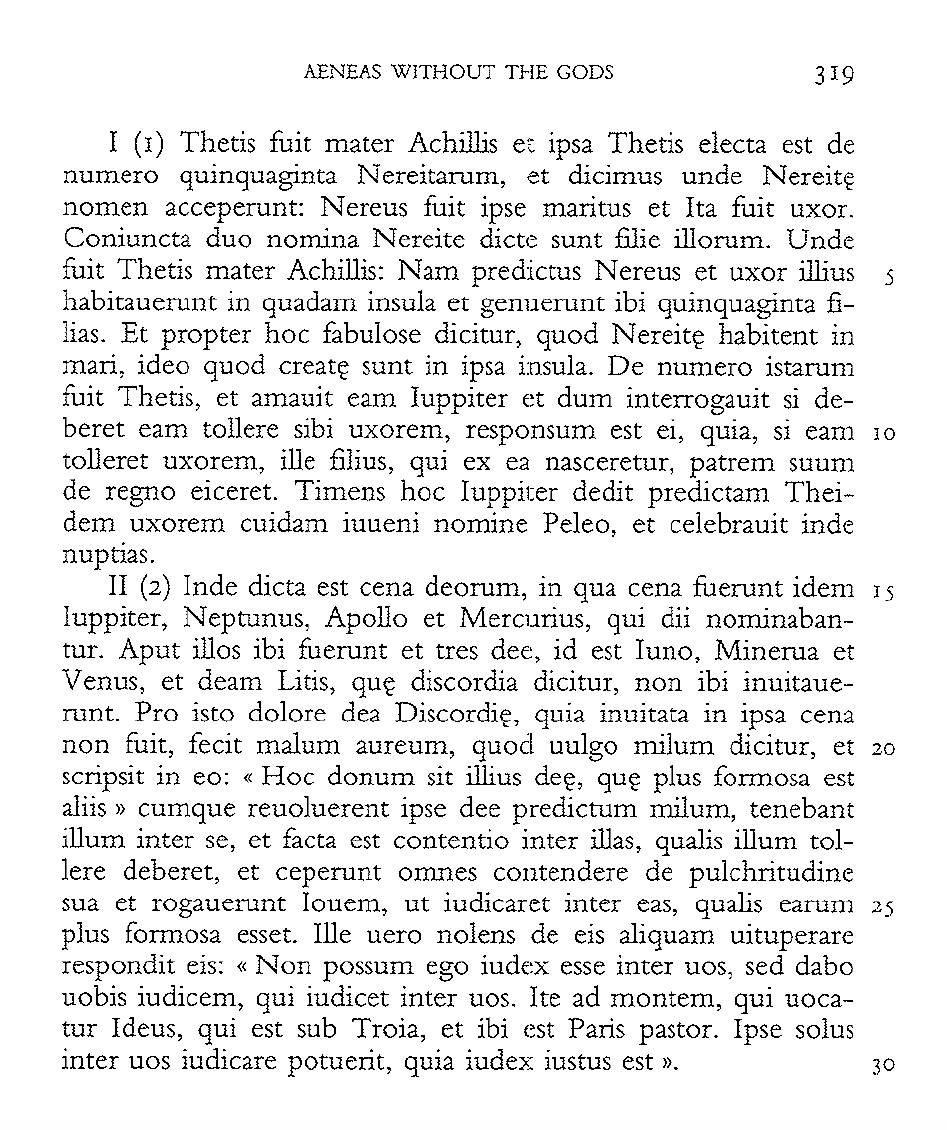
1. Thetis was Achilles’ mother and Thesis was chosen from among 50 Nereites, and we will say from where the Nereites got their name. Nereus was the husband and Ita was the wife. And so with the two names combined, their daughters were called Nereites. Thetis was Achilles’ mother, for the aforementioned Nereus and his wife lived on an island and there they begat 50 daughters. Because of this, it is said in myth that the Nereites live in the sea, because they were begotten on that island. Among these Nereites was Thetis. Jupiter loved her, and when he asked whether he should take her as his wife, the response was given to him that if he were to take her as his wife, the son born to her would depose his father. Fearing this, Jupiter gave the aforementioned Thetis as a wife to a young man called Peleus, and thus he held wedding celebrations.
2. Hence the event was called the feast of the gods, for Jupiter, Neptune, Apollo and Mercury (who were called gods) participated in it. With them also were three goddesses: i.e. Juno, Minerva and Venus, but they did not invite the goddess of Lis,[i] whose name means discord. Owing to the grief she felt because she was not invited, the goddess of Discordia made a golden apple that is commonly called milum, and wrote on it: ‘Let this be the gift of the goddess who is more beautiful than the others. When the goddesses beheld the aforementioned milum, they held it among themselves, and a dispute arose among them as to who should take it, and all of them began to argue about their beauty. They asked Jupiter to judge among them as to which one of them was most beautiful. But he did not want to rebuke any of them and replied: ‘I cannot be the judge between you, but I will give you a judge to judge between you. Go to the mountain called Ideus which lies under Troy. Paris the shepherd is there. He alone will be able to judge between you, because he is a just judge.’
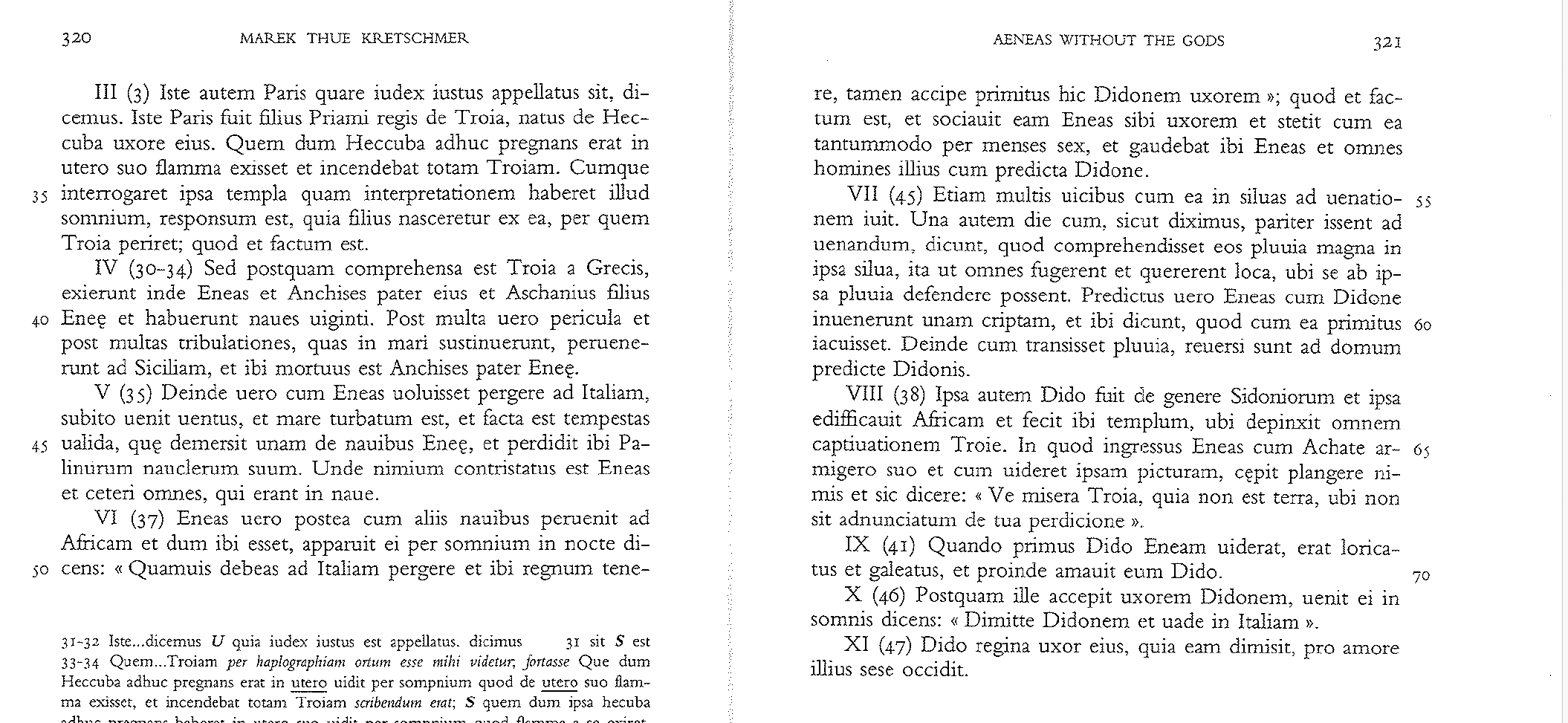
3. We will say why this Paris was called a just judge. This Paris was the son of King Priam of Troy, born to his wife Hecuba. While Hecuba was still pregnant with him in her womb, a fire broke out and burned all of Troy. When she asked the temples what the dream meant, it was said in response that a son would be born to her through whom Troy would perish. This is what happened.
4. But after Troy was captured by the Greeks, Aeneas, his father Anchises and Aeneas’ son Ascanius got out. They had 20 ships. After facing many dangers and many tribulations they endured at sea, they reached Sicily. There Aeneas’ father Anchises died.
5. From there, when Aeneas wanted to go to Italy, a wind suddenly came, and the sea was stirred, and an intense storm arose, which sank one of Aeneas’ ships. And there he lost his skipper Palinurus. Hence Aeneas and all the others on the ship were very saddened.
6. Subsequently, Aeneas reached Africa with his other ships. While he was there, something appeared to him in a dream during the night, saying: ‘Although you should go to Italy and rule there, nonetheless first accept Dido here as your wife.’ This is what happened. Aeneas married her but only stayed with her for six months. Aeneas, all his men and the aforementioned Dido were joyful.
7. On many occasions Aeneas went with her to hunt in the woods. One day when, as we have said, the two went together to hunt, they say that a great rain-shower caught them in the word, such that all fled and they looked for places to protect themselves from the rain. Aeneas and Dido found a cave, and there they say that he first lay carnally with her.[ii] Then when the rain-shower passed, they returned to Dido’s home.
8. Dido was of the Sidonian race. She built Africa and established a temple there where she depicted the entire story of Troy’s captivity. Aeneas entered the temple with his arm-bearer Achates and when he saw the picture, he began to weep greatly and thus say: ‘Woe is you, poor Troy, for there is no land where there has been no announcement of your perdition.’
9. When Dido first saw Aeneas, he was wearing his breastplate and helmet, and thus Dido loved him.
10. After Aeneas took Dido as his wife, something came to him in his dreams, saying: ‘Leave Dido and go to Italy.’
11. Queen Dido, Aeneas’ wife, killed herself out of love for him because he left her.
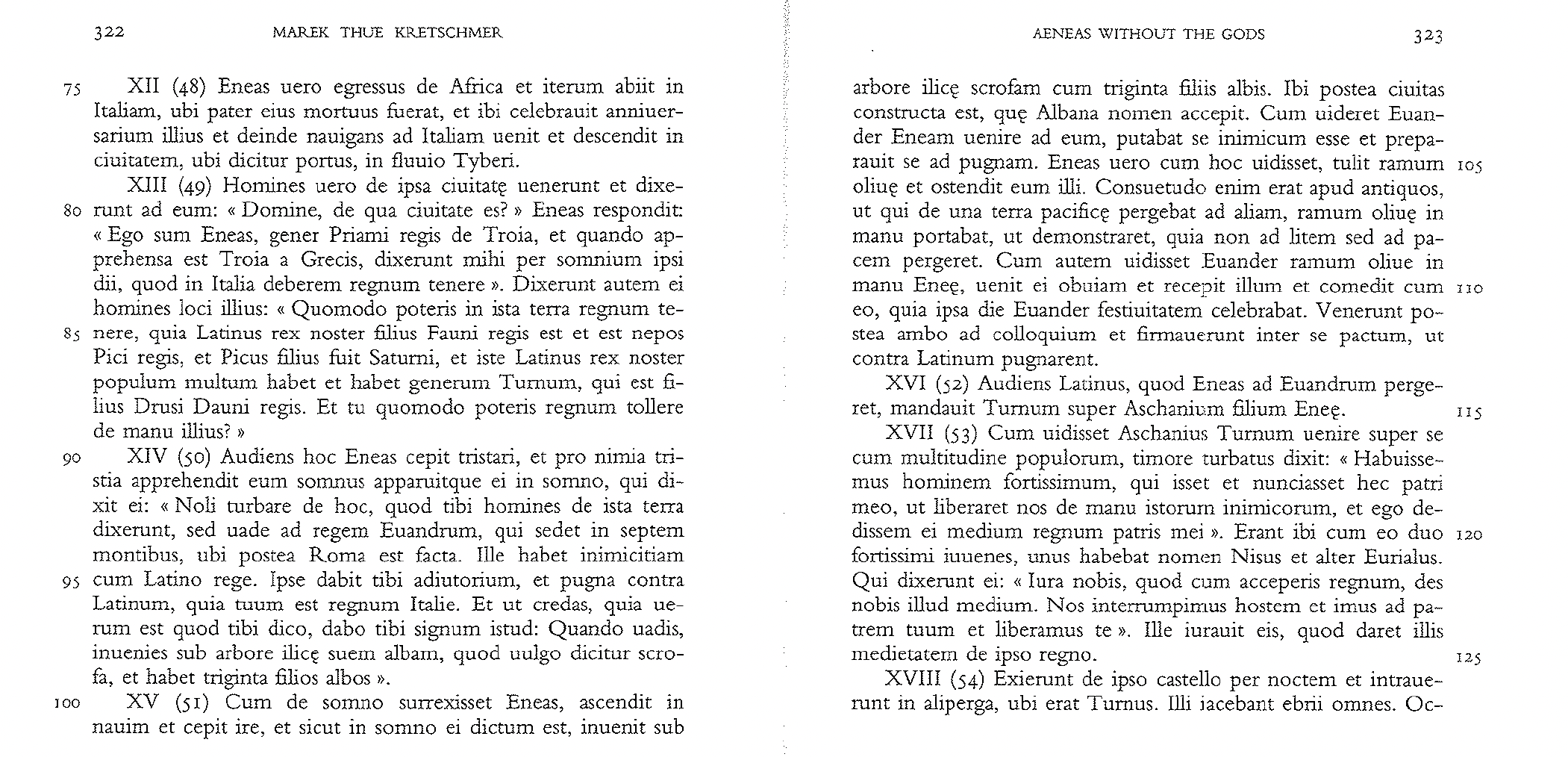
12. Aeneas left Africa and went away to Italy again,[iii] where his father had died. There he celebrated the anniversary of his father’s death, and from there he sailed to Italy and came to the city- called a harbour- on the river Tiber.
13. The men of that city came and said to him: ‘Sir, from which city are you?’ Aeneas responded: ‘I am Aeneas, the son-in-law of King Priam of Troy, and when Troy was taken by the Greeks, the gods told me in a dream that I should rule in Italy.’ The men of that place told him: ‘How will you be able to rule in this land, because our king Latinus is the son of King Faunus and the grandson of King Picus, and Picus was Saturn’s son. This Latinus- our king- rules over a large population and has a son-in-law called Turnus, who is the son of King Drusus Daunus.[iv] And how will you be able to take rule away from him?’
14. Hearing this, Aeneas began to feel sad, and because of his great sadness, sleep came upon him, and something came to him in a dream, telling him: ‘Do not be troubled by what the men of this land told you, but go to King Evander, who resides in the seven hills’ (where Rome was subsequently founded). ‘He is on inimical terms with King Latinus. He will give you help. And fight against Latinus, because the kingdom of Italy belongs to you. and so that you should believe that what I am telling you is true, I will give you this sign: when you set out, you will find a white pig under an oak tree (this pig is commonly called a scrofa). It has thirty white offspring.’[v]
15. When Aeneas woke from sleep, he got on a ship and began to set out, and as was told to him in his dream, he found the scrofa under an oak tree with thirty white offspring. Subsequently, a city was built there that was named Albana.[vi] When Evander saw Aeneas coming to him, he thought Aeneas was an enemy, and prepared to fight against him. When Aeneas saw this, he brought an olive branch and showed it to Evander. For the custom among the ancients at that time was that the one who peacefully came from one land to another would carry an olive branch in his hand in order to show that he was not coming to engage in a quarrel, but rather to make peace. When Evander saw the olive branch in Aeneas’ hand, he came to meet him, received him and dined with him, for on that day Evander was celebrating a festive occasion. Later the two went to have a chat and signed a pact between them for the purpose of fighting against Latinus.
16. When Latinus heard that Aeneas had gone to Evander, he ordered Turnus to attack Aeneas’ son Ascanius.
17. When Ascanius saw that Turnus was coming to attack him with a multitude of men, he was troubled with fear and said: ‘We need a very brave man to go and report this to my father, so that my father should free us from the hand of these enemies, and I should give that man half of my father’s realm.’ With him were two very brave young men. One was called Nisus, the other Euryalus.[vii] They told him: ‘Swear to us that when you become ruler, you will give us half of it. We are going to scatter about the enemy, go to your father, and free you.’ Ascanius swore to them that he would give them half of the kingdom.
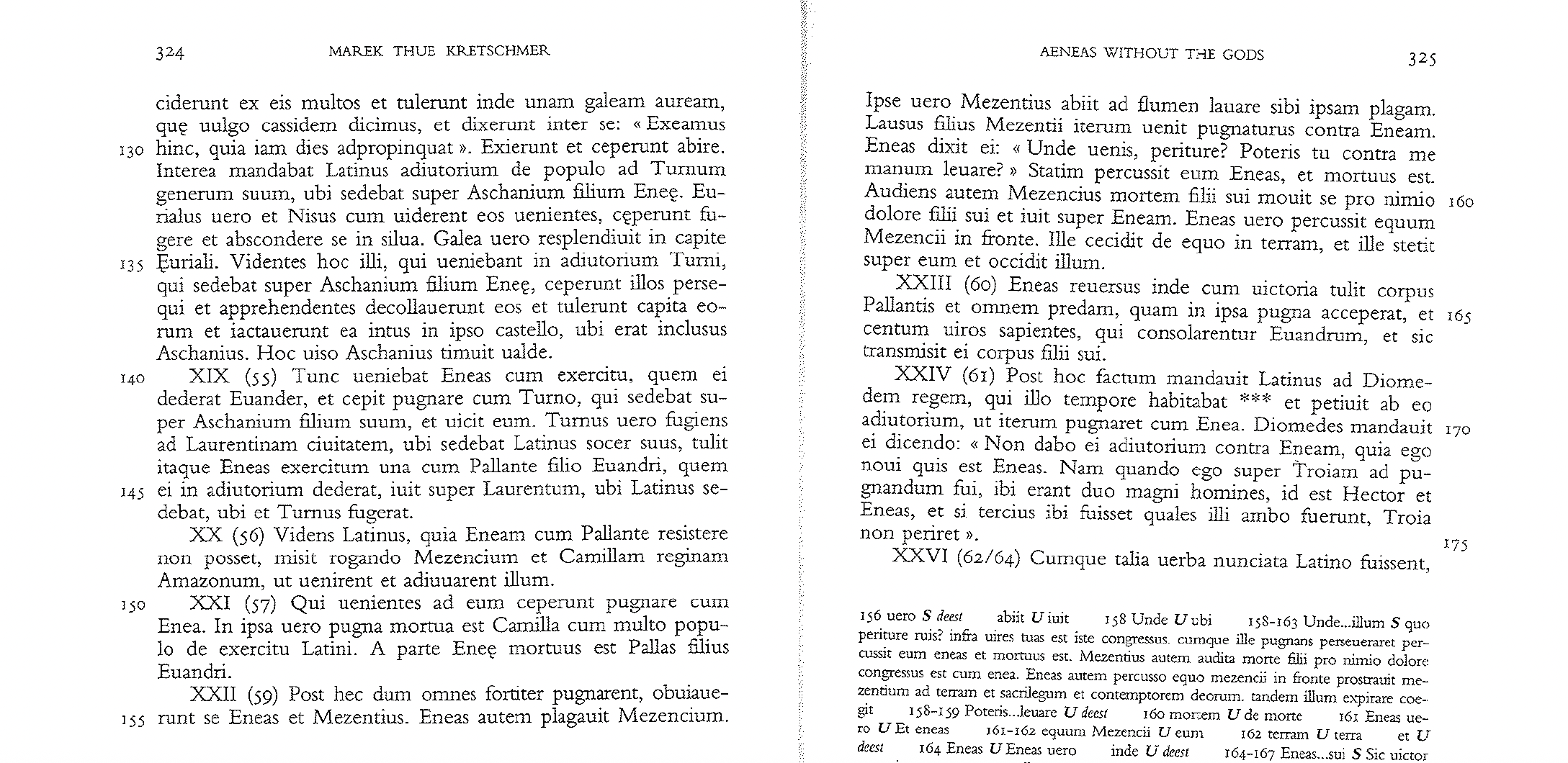
18. They left the fort by night and came to the camp where Turnus was. His men all lay drunk. The two men killed many of them and carried away a golden helmet we commonly call a cassis. They said to each other: ‘Let’s get out of here, for daylight is already approaching.’ They got out and began to depart. In the meantime, Latinus ordered for his people to help his son-in-law Turnus where he was besieging Aeneas’ son Ascanius. When Euryalus and Nisus saw them coming, they began to flee and hide in a forest. But the helmet on Euryalus’ helmet shone. When the men who were coming to help Turnus (who was besieging Aeneas’ son Ascanius) saw this, they began to pursue the two men. They caught them, beheaded them, took their heads and threw them inside the fort where Ascanius was shut in. When Ascanius saw this, he became very afraid.
19. Then Aeneas came with the army Evander had given him, and began to fight against Turnus (who was besieging his son Ascanius), defeating the latter. Fleeing, Turnus came to the city of Laurentum where his father-in-law Latinus was residing. And so Aeneas took his army with Evander’s son Pallas (whom Evander had given to help Aeneas) and went to attack Laurentum, where Latinus was residing and where Turnus had also fled.
20. When Latinus saw that he could not oppose Aeneas and Pallas, he sent a message asking Mezentius and Camilla[viii] (the queen of the Amazons) to come and help him.
21. When they came to him, they began to fight against Aeneas. In that battle Camilla perished along with many men from Latinus’ army. On Aeneas’ side, Evander’s son Pallas died.
22. Subsequently, while all were fighting bravely, Aeneas and Mezentius came to blows. But Aeneas wounded Mezentius. Mezentius went to the river to wash his wound. Mezentius’ son Lausus came to fight against Aeneas for the second time. Aeneas said him: ‘From where are you coming, you who are doomed to die? Will you be able to raise your hand against me?’[ix] Aeneas immediately struck him and he died. Hearing of his son’s death, Mezentius was struck with great grief for his son and went to attack Aeneas. Aeneas struck Mezentius’ horse from the front. Mezentius fell onto the ground from his horse, and Aeneas stood over him and killed him.
23. Aeneas returned victorious and carried Pallas’ body and all the booty he had taken in the battle. He sent Evander his son’s body together with 100 wise men to console Evander.[x]
24. After this happened, Latinus sent a message to King Diomedes who was living in [...][xi] at that time. Latinus asked him for help so he could fight against Aeneas again. Diomedes sent him a reply, saying: ‘I will not give you help to fight against Aeneas, because I know who Aeneas is. For when I went to fight against Troy, there were two great men there (i.e. Hector and Aeneas), and if there had been a third man who was just like them, Troy would not have perished.’
25. When such words were reported to Latinus, he sent a message to Aeneas, suing for peace. Aeneas sent him this reply: ‘Tell your king Latinus that I did come to this land by my own will, but rather the gods told me in a dream that I should possess the kingdom of Italy. And tell him: what benefit is it if so many people perish? Let Turnus and me fight. Whoever wins should be his son-in-law.’ Hearing this, Latinus said: ‘Truly Aeneas has spoken rightly. Why should so many men perish for one maiden? Let the fight each other. Whoever wins will receive her as a wife, and we will serve him.’ This decision was pleasing to all.
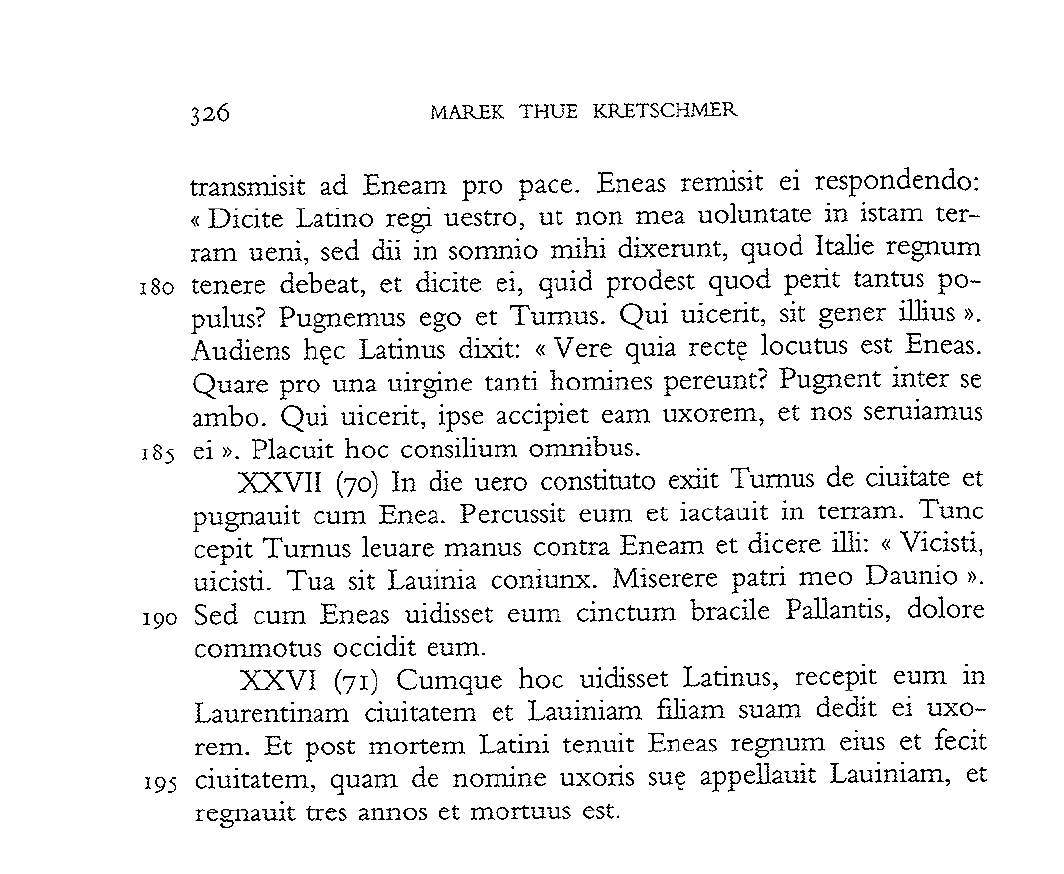
26. On the appointed day, Turnus left the city and fought against Aeneas, who struck him and cast him onto the ground. Then Turnus began to raise his hand against Aeneas and tell him: ‘You have won, you have won. Let Lavinia be your wife. Have mercy on my father Daunius.’ But when Aeneas saw Turnus girded with Pallas’ girdle, he was moved with grief and killed him.
27. When Latinus saw this, he received Aeneas in the city of Laurentum and gave him his daughter Lavinia to be his wife. After Latinus’ death, Aeneas received his kingdom and established a city that he called Lavinia after his wife. He reigned for three years and died.
Notes
[i] The text uses the word Litis, which is the genitive form of lis (meaning strife/dispute/discord/quarrel).
[ii] A similar scene is described in Aeneid IV, with Dido interpreting the carnal union as proof of marriage.
[iii] As written in the text, though the writer surely meant to say Sicily.
[iv] In the Aeneid, Daunus is the king of the Rutuli and Turnus’ father.
[v] A prophecy about a pig with thirty offspring is related to Aeneas in Aeneid III by Helenus. According to Helenus, it will be the site of Aeneas’ future city, marking an end to his toils.
[vi] Linked to the Latin word albus, which means ‘white.’
[vii] Their expedition is described in Aeneid IX.
[viii] Camilla features prominently in Aeneid XI, though she is not described there as the actual queen of the Amazons. Rather she leads a band of female warriors and they are likened to the Amazons.
[ix] cf. Aeneid X, where Aeneas says menacingly to Lausus who seeks to save his father: ‘quo moriture ruis maioraque viribus audes? fallit te incautum pietas tua’ (’Whither are you rushing, you who are doomed to die, and are you daring to do what goes beyond your strength? Your dutifulness deceives you in your lack of caution’).
[x] In the Aeneid, the escort for Pallas’ body consists of 1000 men.
[xi] Gap in the original text. Diomedes is a Greek ruler residing in Italy. The Latins petition him for help to fight Aeneas but in Aeneid XI he indicates he has no desire to help them: either they should seek help elsewhere or make peace with Aeneas.